
Doorstop Club Packet
Congratulations! You’re starting a club that will pay it forward. Underclassmen will not have to learn everything the hard way anymore. They can feel safe, empowered, and competent.
They will learn how to navigate your school’s “hidden curriculum” (the unwritten rules you need to know to succeed), build better relationships with teachers, self-advocate, find new extracurricular activities, learn soft skills, and leave the school better than they found it.
In this guide, you’ll find a curated set of resources, advice, and activities you can run in club meetings. Please reach out to ben@fix.school or 781-330-6849 if you have any questions or need support.
Warmly,

Ben Guzovsky
Founder, Doorstop Education
Prefer paper? Download the packet as a PDF.
Section 1
How to use this packet
Six sections, each starting with a page for you, the student leader, on how to teach it.
- 01
Start with the first page of a section.
It explains how to teach the skill to your peers and gives you an activity to run. The guides that follow are good reference material.
- 02
Teach one thing per meeting.
Younger students remember a single idea they practiced out loud better than ten concepts they heard once.
- 03
Practice during the club meeting.
Roleplay in pairs, draft the real email, make a real change. This also makes meetings more fun!
- 04
Use the online versions when you want to go further.
Every guide links to an interactive page on fix.school for students who want more details.
Section 2
Student–Teacher Relationships
How to resolve conflict with teachers, learn more in class, and stop feeling trapped at your desk.
How to teach this
Almost every “my teacher hates me” turns out to be something smaller and more fixable: a grade, a rule, a bad explanation, a feeling of being ignored. Most freshmen stew in silence or blow up. This meeting teaches a third option: find what is really wrong, get to know the teacher first, rehearse, then say it calmly.
The four ideas to get across
- 01
Dig for the root issue
“She hates me” is a feeling, not a problem you can fix. Ask three questions: What did they actually do or say? How often, and does it happen to anyone else? What do you want to be different? The answers sort into a few real problems (unfair treatment, a grade, no help, bad explanations, too much work, unfair rules), each with its own right move. The next guide maps them all.
- 02
Build rapport before you need it
Teachers hear complaints all day and almost never hear thanks. Before any hard conversation, ask a real question about the subject, say one specific thing you liked, send a one-line thank-you. Try the five-finger test (the care guide) first: a teacher who seems cold is often just juggling 30 kids. Teacher bingo (2.3) is a week of small moves to practice with.
- 03
Use a script
Every script in the online guide has the same bones: something you genuinely respect, one factual example (not “you’re unfair”), one small specific ask, something you’ll offer back, thanks. Teach the manners too: no swearing, nothing mean, and “I learn best with hands-on stuff” instead of “your class is boring.”
- 04
Rehearse it in pairs
Nobody says it well the first time. Saying it once to a friend who pushes back is the difference between a calm ask and a shaky one.
When a student is ready to ask for something specific, the last page of this section lists the request templates: extensions, moving a test, appealing a grade, switching teachers, and more.
Guides in this section
2.1Beef with a teacher?Say what’s wrong in plain words, find the real problem underneath, then use the right move or the right adult.
Online: fix.school/doorstops/teacher-beef
Online, a student describes the problem and Doorstop sorts it into one of 17 types, then offers a script, a mentor and a practice conversation. Nothing typed there goes to the teacher or school. The scripts and email templates live in the online guide, so this page is the part you teach out loud: find the root issue, build the soft skills, and rehearse.
Find the root issue
| It sounds like… | The root issue | Your move |
|---|---|---|
| “She has favorites and I’m not one.” | Unfair treatment | Talk to the teacher with one factual example. Take the five-finger test first. |
| “I got blamed and I wasn’t even there.” | Punished for something you didn’t do | Ask to talk before or after class. |
| Yelling, insults, mocking you in front of the class. | Mean or disrespectful | Adult first, not alone. |
| Treated differently for race, gender, religion, disability, accent or immigration status. | Discrimination | Adult first. Write down what happened and when. |
| A grade you disagree with, lost work, no late work. | Unfair grading | Ask for a second look, with proof. |
| Extra time, breaks or medical needs not followed. | IEP, 504 or health needs ignored | Ask that the plan be followed and cc a parent. It’s a plan, not a favor. |
| Confusing, too fast, can’t answer questions. | Bad at teaching | Ask for one small change in how it’s explained. |
| Videos, packets, tests on things never covered. | Doesn’t teach | Ask for a short lesson first. The district may require the format. |
| Ignores questions, no extra help, no replies. | Won’t help | Ask for 10 minutes on one specific question. |
| You can follow it; it’s just dull. | Boring | Bring one idea for something to try. |
| Study for hours, blank on the test. | Test stress | Ask for a practice test or a rubric, and offer to start a study group. |
| Hours of homework, three tests in a week. | Too much work | Ask early to move a date. |
| Phone, bathroom or lateness rules. | Unfair rules | Propose a two-week trial of a different rule. |
| “She’s just the worst.” “Weird feeling.” | Not sure yet | Say what the teacher actually does, in one sentence, then find your row. |
A problem with a classmate, a friend, a parent or the cafeteria isn’t a teacher problem, and none of this fits it. Coaches, substitutes and teaching assistants do count as teachers. What a teacher teaches often comes from state standards, the district curriculum or a program like AP. If it’s out of their hands, that is a curriculum conversation, not a teacher one.
Soft skills for the conversation
- Lead with something nice. Start with something you actually like about the class or the teacher. It shows you’re not there to attack them.
- Make eye contact if you can. It shows you mean it. If that’s hard, looking near their face is fine.
- Don’t swear or cuss. Not even a little, and not to show how much it bugs you. It’s the fastest way to get a no.
- Keep it constructive. Nothing outright mean or negative. Instead of “your class is boring,” try “I learn best when we get to do hands-on stuff.”
- Be specific, and own your part. One real example beats “you’re unfair.” Say what you could do differently, too.
- Ask for something small, and offer something back. “Could we try it for a week?” is easier to say yes to than a permanent change.
Rehearse before you talk
Nobody says it well the first time. In the online roleplay a student practices with an AI teacher, by voice or typing, and picks one of four types. Pairs in your club can play the same four.
| Teacher type | What they are like | What works |
|---|---|---|
| Friendly | Warm, but has 150 students and can’t say yes to everything. | A specific, small ask. They want to help, so make it easy. |
| Normal | Polite, busy, short with anyone vague. | Get to the point, with one example. |
| Scary | Stern, few words, respects calm and prepared. | Stay calm, know your facts, don’t fill the silence. |
| Aggressive | Defensive: “Are you telling me how to do my job?” | Start kind, own your part, and keep going. A calm student can win this one over, slowly. |
Build a positive connection first
- Find something to say thank you to them for.
- Ask a real question during class, if you’re usually quiet.
- Say hi and ask how they are when you walk in every day.
- Arrive a few minutes early, if you can, and ask how their day is going.
Once you’ve done those things enough times, you can bring up the hard thing.
2.2Does your teacher actually care?That teacher you think hates you probably doesn’t. They’re trying to convince 30 kids that chemistry matters, which is hard. Here’s a quick way to check.
Online: fix.school/doorstops/care
The five-finger test. Hold up one hand: five fingers. Thirteen questions follow. For some, a “no” puts a finger down. For others, a “yes” puts one down, or brings one back up. Be honest: nobody sees your answers but you. Pick one teacher and answer for that teacher only.
Part 1: The basics
Tick the box for yes. Leave it empty for no. Every empty box puts a finger down.
- Do they know your name?
- Do they get to class on time, with a planned-out lesson?
- Do they stay late after school, or talk to students after class?
- Do they show emotion? Do they ever smile?
Part 2: Red flags
Tick the box for yes. Every ticked box puts a finger down.
- They have CLEAR favorites, or only talk to the popular kids.
- They never make eye contact with you.
- They’ve never tried to talk to you or ask how you’re doing.
- They’re strict for no reason, or just plain mean.
Part 3: Green flags
Tick the box for yes. Every ticked box puts a finger up (bonus fingers count).
- They’re honest. They’ll tell you when the district is making them do something pointless.
- They show up with energy almost every day and never drag through class.
- They put teaching first. Phone on silent, no getting sidetracked.
- They handle tough moments without flinching, like quieting a disruptive kid without embarrassing them.
- They make an effort: they ask about the game or the musical, or run a Kahoot once in a while.
What your count means
| Fingers up | What it means | What to do |
|---|---|---|
| 5 or more | Your teacher really cares. | Tell them. Teachers almost never hear it, and a one-line thank-you email goes a long way. |
| 3 to 4 | Solid, with room to grow. They’re doing a good job, but there are things they could do better. | Most teachers want to hear what would help, if you bring it up the right way. Use a script from the teacher-beef guide. |
| 1 to 2 | This teacher could be doing more. That doesn’t mean they hate you. | A good time for a calm, honest conversation about what would help. Rehearse it first, using the pair roleplay on the opening page. |
| 0 | This is really concerning. | Flag what’s going on to another staff member you trust, like a counselor or a teacher you like. You shouldn’t have to deal with this on your own. See fix.school/doorstops/mean. |
2.3Teacher bingoA teacher who knows you is a teacher you can talk to. Build it a little at a time, before you need anything.
Online: fix.school/doorstops/care
Rapport is made of small, real moments. Most students only talk to a teacher when something is wrong, which makes every conversation harder. This card is a week of tiny moves. Do them before you need to ask for anything.
Teacher bingo
Mark each square when you do it, and mean it.
2.4Templates for common requestsWhen a student is ready to ask for something, these guides write most of the message for them. Each is a page online with emails you can copy.
Send the message early, keep it short, and say what you will do in return. Before anyone sends one, run it past a friend in pairs: read it aloud, and see how it sounds to the person on the other end.
Section 3
Life Skills
Nine everyday skills (the ones nobody grades) that make school easier and make adults take you seriously.
How to teach this
Life skills, or “soft skills,” are the things you do with other people and with yourself that no class tests: noticing how you feel, staying calm when it counts, managing your time, asking for help, writing a clear email. Nobody teaches them, and they decide who gets the extension, the recommendation letter and the meeting with the principal. Every skill in this section comes with a small, concrete move a 9th-grader can try this week.
How to teach a skill: read, practice, debrief
- 01
Read a short piece together (5 minutes)
Pick one guide. Take turns reading the five or six steps aloud. Don’t summarize it for them, and don’t lecture. The guides are short on purpose.
- 02
Practice in pairs (10 minutes)
This is the meeting. Every guide has something students can say, write or try right now. Pairs beat a full circle: nobody is performing for the whole room, and everyone talks.
- 03
Debrief and assign a small task (5 minutes)
Ask “what was hard?” before “what did you learn?” Then give one tiny task before the next meeting: ask one small question, send one two-line email, write one thing that went better than expected.
Guides in this section
3.1NegotiatingAdults don’t take bad deals. Kids do. You don’t have to.
Online: fix.school/skills/negotiating
Why it matters
You can negotiate for almost anything, and you’re going to have to. Getting a raise, buying a car, compromising with your significant other. School is your first opportunity. Anything can be a negotiation once you realize you have leverage.
A test date, a late-work policy, the seating chart, the phone rule, what happens the Friday before break: somebody decided each of those, and most of them can move. Teachers want an engaged class. Admins want fewer complaints. That’s your leverage.
Build stronger negotiating skills
Look for opportunities in class to negotiate. If you feel like you’ve been assigned too much homework, don’t just groan: propose a solution.
- 01
Find out what they want.
A teacher worried that retakes reward cramming might say yes if students have to do test corrections first.
- 02
Bring an offer, not a complaint.
“Could we move the test to Monday if we use Friday for a review game?” beats “this is too much.”
- 03
Know your fallback.
Ask for Friday, be ready to take Thursday night.
- 04
Get it in writing.
Send a two-line email that closes the loop.
- 05
Treat “no” as information.
Ask, “What would need to be true for this to work?” and come back with that.
Activity: The pizza negotiation
A negotiation game with real pizza. Pairs get one slice and a secret card. The first round is about style: how you negotiate changes what you get, and how it feels. The second is you, as yourself: what do you actually want from the slice, and can the two of you agree? The optional third is a real school issue. Everyone eats at the end.
- 01
Pair up and set the rule (2 minutes).
Each pair gets a plate with one slice. Nobody eats until both of you say yes out loud. If there is no deal in four minutes, the slice goes back in the box.
- 02
Round 1, style (5 minutes).
Each player gets a style card. Read it, keep it secret, and negotiate how to split the slice in that style. Be pushy if your card says so, but never mean: no insults, and nobody touches the pizza before the deal. Afterward, guess your partner’s style and say how it felt.
- 03
Round 2, as yourself (5 minutes).
New partner, new slice, no cards. Play yourself. Decide what you actually want from the slice (the cheesy middle, the crust, a few bites, most of it) and see if the two of you can agree. Ask what your partner wants before you propose anything.
- 04
Round 3, optional (5 minutes).
A real school issue instead of pizza: the date of a test. One of you plays the student and the other plays the teacher, using the Round 3 cards. Can you agree on a date? Swap roles and try again if there is time.
- 05
Debrief (8 minutes), then eat.
Use the questions on the last page.
Style cards
Round 1. Deal one to each player. Keep it secret, and play it for real.
Round 3 cards: the test date
Optional. One student and one teacher per pair. Keep your card secret.
3.2Writing Great EmailsA clear email gets a fast yes. A messy one sits unread.
Online: fix.school/skills/email
Why it matters
Email is how adults get things done. Extensions, meetings with the principal, recommendation letters, summer jobs: they usually start with an email.
The basics
- 01
Write a subject line that says what and why.
“Question about Friday’s lab report,” not “hi” or “URGENT!!!” Keep it under about 60 characters so it doesn’t get cut off.
- 02
Get the greeting right.
Anyone who works for the school or district (teachers, counselors, principals, board members) gets a title and last name. People outside the school system, like a reporter, an alum, or a local business owner, get their first name.
- 03
Match the formality.
Full sentences, no slang, no emoji, and never “hey” to an administrator. Sign off with “Thank you,” or “Best,” plus your full name.
- 04
Get to the point.
Your first sentence says why you’re writing. Then go line by line and ask: does cutting this remove meaning? If not, cut it.
- 05
Use short paragraphs, one idea each.
Nobody reads a wall of text on a phone.
- 06
Make one clear ask, and make it easy to answer.
Yes-or-no questions and specific times (“I’m free to meet Tuesday or Thursday after school”) get faster replies.
- 07
Follow up politely.
Wait two or three school days (a week for busy admins), then reply in the same thread: “Just bumping this in case it got buried!”
- 08
Proofread once.
Read it aloud, check their name, check the attachment. Send.
| Who you’re writing to | Greeting |
|---|---|
| School or district (teacher) | Hi Ms. Rivera, |
| School or district (a doctor) | Hi Dr. Lee, |
| Outside the school system | Hi Dana, |
| First line, before: 31 words | First line, after: 10 words |
|---|---|
| I’m writing to you today because I was hoping that maybe you might be able to help me with the lab report that we have due on Friday, if that’s okay | Could you help me with the lab report due Friday? |
Don’t reread it a dozen times. Send.
A sample email to a teacher
Hi Mr. Patel,
I have a debate tournament Wednesday night that will run late, so I’m worried about finishing the history essay due Thursday.
Could I turn it in Friday morning instead?
My outline is done, and I can send it to you Thursday so you can see where I’m at.
Thank you,
Jordan Kim, 3rd period
The subject is 46 characters, so it fits on a phone and says what and why. Notice the three jobs: why you’re writing, in the first sentence; one clear, specific ask; and proof you’re taking it seriously.
Activity: Email speed-edit
Pairs rewrite messy emails using the checklist from the email guide, then trade rewrites with another pair, who play the recipient. The test is simple: can they answer in one line?
- 01
Warm-up (3 minutes).
Take this 31-word first line down to about 10 words: “I’m writing to you today because I was hoping that maybe you might be able to help me with the lab report that we have due on Friday, if that’s okay.” (One answer: “Could you help me with the lab report due Friday?”)
- 02
Rewrite (4 minutes each).
Pairs get one bad email at a time. Rewrite it on a laptop or on paper. Fix as many checklist items as you can, and aim for a first line of 15 words or fewer.
- 03
Reply test (2 minutes each).
Trade rewrites with another pair. Read it as the recipient and answer in one line, or say, “I’m not sure what you want.” If the reply is confused, the writers fix it and try again.
- 04
Debrief (5 minutes).
Which fix saved the most words? Which one changed how the email felt? What would you change in your own last email?
Five bad emails
hey Mr. Patel!!! so i was gonna do the history essay but then my week got really crazy and i have a debate thing and a shift at work and my computer is also kind of broken and idk if you got my last email but anyways is there any way i could maybe get more time on it?? let me know thx
The new phone policy is unfair and honestly nobody follows it. Students are mad. You should change it.
a student
Dear Sir or Madam, I am a high school student and I am interested in learning about your business and gaining experience in the field because I want to be successful. I think your company is very impressive and has a lot to offer students like me. I was hoping that perhaps you might possibly consider the potential of an internship, if that is something you do. Please let me know. Sincerely, Sam
Hi Ms. Ortiz, I need to switch out of Chem because the teacher goes too fast and also my schedule has a free period I don’t want and I’m also trying to figure out if I can take AP Lit next year and when the deadline is for the summer program and my mom says I should talk to you about all of it. Also I was out Monday. Thanks
Hello?? I emailed you yesterday and you haven’t answered. I really need to know by tonight.
Hi Mr. Patel,
I have a debate tournament Wednesday night that will run late, so I’m worried about finishing the history essay due Thursday.
Could I turn it in Friday morning instead?
My outline is done, and I can send it to you Thursday so you can see where I’m at.
Thank you,
[Your full name], 3rd period
3.3Cold EmailSerendipity on demand: how to write to someone who has never heard of you.
Online: fix.school/skills/coldemail
Why it matters
Every email to someone new can turn into something: advice, feedback, a friend, a summer job, or the name of who to email next. Everybody has an email address and checks it religiously. A spot in their inbox is free.
Worst case? No reply. Best case, a school board member, a local reporter, or an alum doing your dream job is a few sentences away. Along the way you learn to pitch yourself, write better, and find out that almost anyone is reachable.
This guide is about who to email and how to make them care. For subject lines, greetings, short paragraphs and proofreading, start with “Writing Great Emails.”
Practice with five emails
Do these in order. Each one is a little scarier than the last.
- 01
Pitch yourself.
Email yourself about what cold email could do for you: goals, questions, people you’d love to meet. Give it a subject that shares the gist and a reason to click, built around a verb: “Asking about the late-start proposal.” The point is getting comfortable hitting send.
- 02
Email a friend.
Something low stakes you’d normally text. Formality matches context, so write it the way you’d talk to them. Try making your first line as short as it can be without losing meaning.
- 03
Send something you care about.
Still to a friend, but now it matters to you: a proposal, a poem, a problem at school that bugs you. Notice how your feelings show up in the words you pick.
- 04
Ask a stranger a question.
Your first real cold email. Find a local reporter’s article about your district and ask them something about it. Introduce yourself, show you read it and cared, ask your question. Value your ideas more than two minutes of their time. If you’re not sure how to greet someone you don’t know: outside the school system, “Hi Dana,”; teachers, principals and board members, “Hi Ms. Reyes,”. If they sign off with their first name, you can follow their lead.
- 05
Take the plunge.
Something personal: a small ask, a story, a shot in the dark. An alum, a school board member, the author of a study your teacher assigned.
You won’t hear back from everyone. Trust your value and keep going. A few emails a week beats twenty in one night.
Find the person
There’s an email behind almost everything you read or watch. The district website lists board members. The local paper lists its reporters. Your counselor knows alumni. Authors and researchers usually list a contact, and a creator’s manager usually has one too.
When you have a name but no address, search in this order: their own website, then a public profile, then an email-finder tool as a last resort.
A worked example
When our founder Ben was building a writing course, he wanted a climate writer (call him Steve) to record a short video for students. Finding Steve’s address took three minutes: Steve’s own site first, then a public profile where he’d listed it.
Hi Steve,
[Who Ben is, and what he liked about the article.]
Would you be interested in recording a quick two minute video about that writing process, and how you use writing to develop and challenge your ideas? It would add so much value to my students’ learning experience.
The subject is 64 characters. A phone shows roughly the first 40, so the front half has to do the work. “Loved your climate offsets article” does.
Cut until it hurts
Ben’s draft opened with “I’m emailing because.” It said nothing, so it went. Do the same to your own first line: for each phrase, ask whether cutting it loses any meaning. If not, cut it.
| First line, before: 32 words | First line, after: 13 words |
|---|---|
| I’m emailing because I wanted to share something I’ve been working on related to our school’s phone policy, and I was wondering if you might possibly have time to look at it. | I have an idea about our school’s phone policy. Could you take a look? |
Don’t reread it a dozen times. Send.
Make them care
People don’t have short attention spans. They have short decision spans. The first few sentences decide whether they keep reading.
- Passion first. Be personal and open right away. Why does this matter to you?
- Signal credibility. A project, a survey, your role (“student council treasurer”). Link to it instead of pasting it in. A school email address helps.
- Ask, don’t assume. Not “I’d love to meet,” but “Would you be free to meet?” Offer a few times so replying takes one line.
- Effort shows. A one-page plan or a short slide deck can turn a cold email into a meeting, and sometimes a mentor.
Skip anything that sounds spammy (“free,” “buy now”), pandering, or demanding.
Getting to someone important
Want the superintendent, the mayor, or a state legislator? One cold email can work. A path usually works better.
| The path in |
|---|
| You → a teacher → the PTA president → the superintendent |
- Map the circles. Who makes the decision, and who do they listen to?
- Talk to two or three people who know them: a teacher, the PTA president, a board member. They can tell you what the person cares about, and some will offer to introduce you.
- Mention who you’ve already talked to (“I spoke with Mr. Lopez, who thought…”). It shows you’re serious.
- Pitch what they personally care about, not just what their office does.
- Watch for competing interests. The person you get handed off to might not want extra work, so make yes easy for them too.
Here’s that in action. Ms. Alvarez is on the school board. Maya, a junior, watched her speak at a board meeting.
Hi Ms. Alvarez,
I’m a junior at Lincoln High, and I watched your comments on the new phone policy at last Tuesday’s board meeting.
You said the board wants to hear from students before the vote. I surveyed classmates about how phones affect their focus and put the results on one page: [link].
The numbers could help the board, and I’d like your advice on the best way to share them.
Would you be free for a 10-minute call before the next meeting? I’m free after 3:30 on Tuesday or Thursday, or any time that works for you.
Best,
Maya Chen, Lincoln High School
The subject is 40 characters. Four jobs, in order: who you are and how you found them; the specific connection, with a link; why talking helps you both; an easy, specific ask.
Emailing at scale
Sometimes you need a lot of people, like 100 alumni for a scholarship fund. Ben would still rather send 10 targeted emails backed by real work than 100 generic ones. Going broad only beats going targeted when you don’t have much work to show yet.
Make it a habit
Don’t expect most strangers to reply. A few good replies is a win. After your first five, pick a focus for the next five: a summer job, advice on a career, feedback on a proposal. Then teach a friend. For extra credit, rewrite one email four ways (passive-aggressive, enraged, impassioned, despondent) and notice what changes, word by word.
Activity: The 30-minute outreach sprint
This worksheet walks through the mentor and internship guides as a timed sprint. Keep the guides open next to it for the templates and the one-sentence pitch. Done means sent.
- 01
Pick a path (2 minutes)
- Internship: a company near you, or one from the Y Combinator list at ycombinator.com/companies.
- Mentor: someone you read online, or a person from the alumni search in the mentor guide.
- Research: a postdoc, searched with “[college name] [topic] postdoctoral researcher.”
- 02
Find a target (6 minutes)
Write the name and one reason you picked them. ________________________________________
- 03
Do the homework (6 minutes)
- Internship: try their product and write three things you would improve, in your own area of interest.
- Mentor or research: read an article or an abstract and write one honest sentence, such as what you understood and what surprised you.
- 04
Find the email (3 minutes)
- Search for “[person’s name] email” and look around their site.
- At a company, find anyone’s email there. They usually share a format, like firstinitial.lastname@company.com.
- 05
Draft (8 minutes)
- Use the template that fits your path in the guides. Fill every blank.
- Add your one-sentence pitch with real hours in it.
- Offer a narrow time window and a wide one, like “Mondays and Tuesdays after 3pm and any time Fridays.”
- 06
Swap and test (3 minutes)
Your partner reads it against the checklist below.
- 07
Send (2 minutes)
Hit send, then write it in the log below.
| Who I wrote to | Date sent | Follow up on (in 2 or 3 school days) | Reply? |
|---|---|---|---|
| ________________ | ________ | ________ | ________ |
| ________________ | ________ | ________ | ________ |
| ________________ | ________ | ________ | ________ |
3.4Small asks get big resultsAsking an adult for ten hours of help gets you a polite no. Asking for ten seconds gets you a yes, and a yes is how the bigger stuff starts.
Online: fix.school/skills/smallasks
Big ask vs. small ask
The big ask. FAIL.
Youcan you spend 10 hours helping me apply to colleges?
Adultuhhhh no
Adulta little busy
The small ask. Yes.
Youcan you take a quick look at my resume?
Adultyeah totally send it!
Yousmall asks are nbd, you’ll always get a yes
Youand when ya bring up a big ask later…
Adultyou’re more likely to get a yes bc you’ve built some trust!
Small asks to steal
Easy to say yes to, easy to send. Try one this week.
In class
- Can you explain problem 3 again?
- Can I come 2 mins late to class?
- Is there a day we can talk after class?
- Where’s the best place for hw help?
Out of class
- Wdyt of my ig caption idea?
- Are you free to give 10 mins of advice?
- Can I have a bite of your snack?
- Do yk anyone working in a career I’m curious about?
3.5More skills, onlineFive more skills, each a short guide online with its own examples. Pick one when your club is ready for it.
Section 4
Extracurriculars
Find the people, clubs and first jobs that teach you what class never will.
How to teach this
Class teaches what is on the test. Clubs, mentors and first jobs teach the rest: what real work looks like, who to ask when you are stuck, and what you might actually want to do. Most 9th graders never get any of it. Nobody told them they were allowed to ask.
Why these three matter
- Extracurriculars are a place to try things with no grade attached, next to people who care about the same thing.
- A mentor has already done what you are about to do. They tell you their mistakes so you can skip them, introduce you to other smart people, and vouch for you.
- An internship or first job is real work for real adults. It shows you what you can do, and it gives you something true to put on every application after it.
The real obstacle is the send button
Both guides that follow end in the same place: an email to a stranger. So your job as a leader is less to explain what a mentor is and more to get your members past three stalls: who do I write to, what do I say, and what if they say no. The guides answer the first two. The third is on you.
Handling the fear of rejection
Use the club as a platform
A club gives you a reason to write to an adult and a specific thing to invite them to. Teachers have adult friends in the jobs your members are curious about, and they often keep in touch with former students. Ask them. Invite one guest to a meeting for 20 minutes to talk about their path, then end with the question the guides recommend: “Do you know anyone who might need an intern this summer?”
Guides in this section
4.1Find your mentorHow to get a free #1 fan, life coach and career shortcut.
Online: fix.school/doorstops/mentor
Mentors save you time because they have done exactly what you are about to do. They help the way a coach or a friendly older sibling does. They tell you about their terrible life choices, from career chats to the ice cream they ate for lunch every day before they realized they were lactose intolerant. They put you in touch with other smart people, and they vouch for you. Growth. Emotional support. Free food.
Start with what you want
| If you say… | Then go to… |
|---|---|
| “I want to learn from people with cool jobs.” | Choosing a mentor, then the two emails below |
| “I want to do research.” | Email postdocs, not professors |
| “I am not really sure I can do this.” | Pick someone you read about online, or try a program |
Choosing a mentor
Your ideal mentor is a confident college junior or senior, or a recent grad working in an industry you are curious about. Start by asking your teacher whether they know anyone in that industry. Teachers are adults and have adult friends who can help.
Hi [First name],
Do you know anyone who might be open to mentoring a(n) [#]th grader passionate about [topic]?
I come from an under-resourced high school where I don’t have opportunities to explore [topic] outside the classroom, and I’m curious to learn more about it.
[optional sentence about skillset, bio]
With hope and gratitude,
[your name]
Hi [First name],
Do you know anybody at [their organization] who might be open to mentoring me for an hour a week/month? If yes, 30 seconds of your time to forward this email would be invaluable.
[a two-sentence pitch: one about you, one about what you are interested in or passionate about]
With hope and gratitude,
[your name]
The best versions also pitch a project and name a time commitment, for example: “One hour a week sharing insight on [industry] and [answering my questions about it // helping with my XYZ project] would be a 10% increase to my average instructional time per week. I measured it.” You can measure your own weekly instruction time at /time.
Even better, pick someone you read about online. It could be a journalist who wrote something you like, or a video editor who works for a YouTuber you follow. If you are not sure where to start, search “youth mentorship [my city],” or try an online program: ADPList or Matriculate.
site:linkedin.com “[your high school name]” “[a topic you’re vaguely interested in]”
Want to do research? Email postdocs, not professors
Professors are busy and overloaded. Postdocs need to mentor people for their own career progress: their CVs get stronger when they list “last author” publications, where they advise the “first author,” the person driving the research. You can be that first author. Search “[college name] research labs” or “[college name] [topic] postdoctoral researcher,” find their emails, and write.
Hi [First name],
I’m a(n) [#]th grader passionate about [research topic the postdoc is involved in] with [quick pitch: see the next section]. Are there any opportunities for me to contribute at [name of the lab]?
[optional: “I come from an under-resourced high school where I don’t have opportunities to pursue research outside the classroom, so the opportunity to learn from you would be invaluable.”]
[optional sentence about your skillset]
Regardless, I would really value the opportunity to talk more. Maybe we could Zoom or call if you’re free!
With hope and gratitude,
[your name]
Read papers the postdoc has published, even just the abstract if the content is confusing, and mention one in your email. Here is the same compliment three ways, about a paper on cystic fibrosis mucus and gene therapy:
| What you write | Why | |
|---|---|---|
| Bad | “I was particularly struck by Professor Kays’ publication on the effects of cystic fibrosis sputum on the passage of adeno-associated virus (AAV) gene vectors and the strategies outlined for improving AAV diffusion through sputum.” | Do you know what these words mean? Does the student writing this? |
| Mid | “I was struck by the mechanical engineering necessary for Professor Kays’ publication on identifying and combating cystic fibrosis sputum, a type of mucus, as the blocker of adeno-associated virus vectors, which are the main path for providing gene therapy treatment.” | Way too complicated and way too formal. |
| Good | “You’re using so much mechanical engineering to fight the cystic fibrosis sputum, which I thought would be a biochemistry problem. Even just reading your abstract about this, I feel like there’s so much for me to learn!” | Admits you don’t understand everything, shows what you did understand, and shows you are interested. |
Write an amazing one-sentence self-pitch
Allison is a college sophomore. She has worked in a lab for a year but feels like she has not achieved much: no papers, nothing flashy. She loves the work and gives it a lot of time. Here is her one-sentence pitch:
Allison is a UC Berkeley sophomore with 300 hours in an imaging systems lab; 50 hours in 1:1 conversation with biomed PIs, professors, and founders; and 100+ iterations of nanoparticle synthesis.
She focused on what she has done the most of, and readers realize that is a lot of hours for a sophomore. For cool phrases, look at the back of books and borrow from reviewers talking about the author. That is where Allison found a line in her longer bio: “When energy levels are low, she is a one-woman defibrillator.”
Say you want to do cancer research and you have only taken one chemistry class. Phrase it like this:
I’m an 11th grader interested in cancer research. In my chemistry class, I stay late to ask my teacher questions and help clean up.
Or do a little math:
I’m an 11th grader interested in cancer research with 300 hours invested in learning chemistry and biology, 50 hours practicing experimental design in class activities, and (not that it’s relevant) a really cute dog.
Can’t find their email?
- Google “[person’s name] email” and poke around.
- If you get results from a site like Apollo or Rocketreach, it is fine to make a free account to see emails. Those sites are legit.
- If they work at a company, find someone’s email there. All the emails will follow the same format, like firstinitial.lastname@company.com.
Not sure what careers interest you? The Doorstop guide on finding careers is still being built, so for now use the “not sure” path above and ask a teacher what they would try.
4.2How to get an internship as a high schoolerOther guides tell you to ask neighbors or google “internship for high schoolers [your city].” That is fine. This email gets you further, faster.
Online: fix.school/doorstops/intern
- 01
Choose a company near you, or one you like online.
Try the Y Combinator list of companies (ycombinator.com/companies). You can filter by industry, and a lot of them would take high school interns because they are new: they need smart people who are happy to help, and they do not care whether you have a college degree.
- 02
Find three things you would improve.
This is how you impress them. Try out their product: what was annoying, boring, or a missed opportunity? Think about how they make money: what else could they do? Give suggestions on what you are interested in, whether that is design, marketing or video.
- 03
Email them and ask for an internship.
Use the template below. Offer a narrow time window and a wide one, like “Mondays and Tuesdays after 3pm and any time Fridays.” It makes it easy to say yes.
Hi [First name],
I’m a [#]th grader that loves your mission for [product name // restate their mission statement // quickly explain why the company is cool to you].
I tried out your product and noticed a couple of opportunities I could work on over [the summer // winter break // whenever you want to work]:
- [opportunity #1 + how YOUR skillset or experience can help]
- [opportunity #2 + how YOUR skillset or experience can help]
- [opportunity #3 + how YOUR skillset or experience can help]
[optional: “I come from an under-resourced high school where I don’t have opportunities to pursue work outside the classroom, so the opportunity to work with and learn from you would be invaluable.”]
Are you free to talk about how I could contribute? I’m free [narrow time windows, e.g. Mondays and Tuesdays after 3pm] and [wide time window, e.g. anytime Fridays].
With hope and gratitude,
[your name]
Too ambitious? Play it cool
Start with a small ask. Anyone you find in a career you are interested in will probably be open to a 30-minute conversation, an informational interview, and you can wrap one up by asking if they know anyone looking for interns.
Do you know anyone who might need an intern this summer?
Section 5
College
Advice and guidance for college applications, with material for all grades 9-12.
How to teach this
A club with ninth graders and seniors in one room is a great place to talk about college and an easy place to ruin it. If the talk becomes “where are you applying?” and “what’s your GPA?”, half the room goes quiet and the other half gets competitive. Point it at things people can actually do.
Start with what every 9th and 10th grader can do now
Underclassmen have nothing to “list” yet, which is good news: they have years to build real things. Teach these three.
- Know your teachers, and let them know you. Two teachers will write about you one day. Earn a good letter by asking for help, showing up early and caring about class, never by trying to “get the recommendation.”
- Follow what you’re actually curious about. Doorstop’s read of Harvard’s own documents is that passionate students get in, and that passion can be an engineering award or amateur painting. Passion you can’t show doesn’t help, so practice.
- Learn what colleges actually read. Every college publishes a common data set that lists which factors it weighs. Showing a ninth grader that table kills a lot of myths.
Run an essay circle, not an essay contest
Seniors need readers, and juniors learn by being readers. Groups of three or four, same moves every time. The writer reads aloud, then stays quiet while everyone else answers in order:
- 01
Say back what you heard.
“I heard a story about your grandfather’s garage and what it taught you about patience.”
- 02
Say what stood out.
A line, an image, a feeling. Be specific.
- 03
Ask one question.
The one a stranger reading it would have.
- 04
Stop.
No grammar fixes and no “you should write about…” in the circle. The writer says thank you and takes notes.
Nobody ranks topics. If someone shares something heavy, such as mental health, thank them and keep it short. The insider guide links both sides of whether that belongs in an essay; suggest a counselor or teacher as a second reader.
Juniors: get ready to ask for recommendations
Colleges look for one humanities and one STEM recommendation, so help each junior pick a class in each. Then the work is ordinary: ten minutes early for a week, one real question after class, your best self in those two rooms. A good letter comes from a relationship, not a request email.
Anxiety and comparison
Set three rules out loud: no comparing school lists, no trading scores or rankings, and questions are about what a person is curious about, not where it will take them. When someone panics, remind them that, by Doorstop’s reading of Harvard’s documents, admissions is imprecise and has no review that checks decisions against long-term success. Aim for a room where seniors would rather share a draft than a status.
Guides in this section
5.1Insights on the college processRarely talked about strategies, ideas, and what-not-to-do’s.
Online: fix.school/doorstops/college/insider
Get research opportunities by emailing postdocs, not professors
Professors are old, tired, and bored. Postdocs need to give mentorship for their career progress. Their CVs get much stronger when they list “last author” publications, or publications where they advise the “first author,” the person driving the research. You can be that first author! Read scientific papers in your field, look for authors who are postdocs (usually, if you’re doing a search on Google Scholar for journal articles, postdocs are first or second authors), find their emails, and reach out! They’ll be much more responsive than professors.
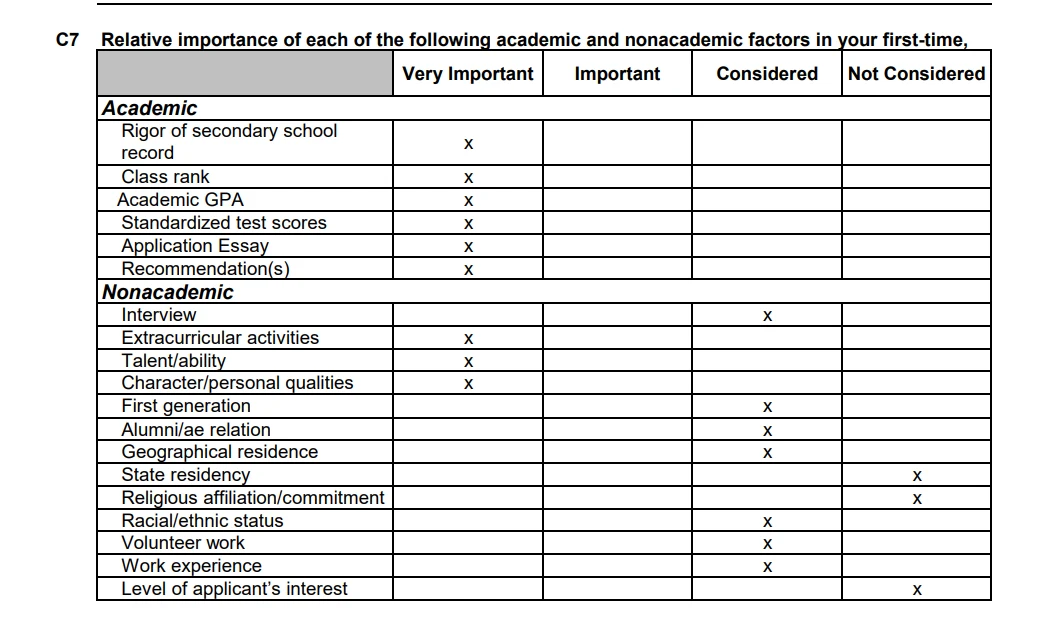
Look at a college’s common data set to see what factors it considers
Search for “[college] common data set” and you’ll see a table of what they look for, usually on page seven or eight. This information can help you focus your energy on what your top schools care about.
If you don’t have a top choice, apply to a target school EA
If the schools you’re most interested in don’t consider demonstrated interest as a factor, this will save you time. Why send your first application, your first attempt at something new and challenging, to one of your top choices if they won’t even give you preference for applying early? Get some practice writing essays first. Apply to a school in the upper-middle part of your list (with a generous financial aid track record if that’s important to you). That way, if you get in, you won’t have to waste time applying to schools you’re less excited about.
Don’t waste your activities list
You only have 150 characters to talk about the ten things you spend the most time on. Minimize the space you spend writing anything that isn’t unique to you. Don’t waste it saying “organized, publicized, and ran club meetings” when your title of Club President already implies that. Focus on specific achievements that most other club presidents have not achieved and humanize your activities: don’t be afraid to share a personal touch.
Be very careful talking about mental health in essays
The topic is not completely off limits, but it must be handled with extreme care. Read the case against mental health in essays first. Then read the case for writing about trauma and other sensitive topics, as well as mental health if you’re really feeling bold. If you do choose to write about difficult subjects, understand that the topic is not straightforward.
Two more rules of thumb
- Hedge risky bets.
- Don’t use crazy, essay-spanning metaphors, but do have a theme.
5.2How and why to ask for helpBefore junior year starts, understand that two of your teachers will be your recommenders.
Online: fix.school/doorstops/college/support
Your recommenders will be the only non-you humans present in your application. They will give a fair perspective on who you are and what motivates you. It won’t seriously harm your application if your recommendation letter sounds like every other student’s, but it will be a wasted opportunity.
Besides working hard and smart in class, here’s how to stand out: ask for help, be early, and bring your best self to at least two classes.
Start with a few honest questions
Ask yourself, do you ask for help when you need it? Do you help others when they need it? Are you on time, or early? Are you listening attentively? Do you ask questions that make class more interesting? Do you care about class, and does it spark your curiosity? If your intuitive answer is no, here’s the best reason to change your mind: you have to sit through class anyway, so wouldn’t it be rewarding to try making it interesting?
Bring your best self to two classes
Going above and beyond in classrooms, whether that’s asking for help on a topic you’re struggling with or asking for extra material on a topic you’re excited about, is the best way to develop curiosity, open-mindedness, and psychological flexibility. Make a conscious effort to bring your best self to at least two classes, but don’t force it. Your intention shouldn’t be getting the recommendation. Not only will your teacher see through any excessive sucking up, here’s the juicy bit: give this experience a genuine effort, with the goal of helping others, of being flexible, kind, curious.
You don’t build teacher friendships by acting all tough and smart and network-y. You do it by being vulnerable: by asking for help on small things, by opening up, by respecting yourself and others, and, if you can, by being irreverently kind. Doing these things is not “hard” like solving a tricky math problem is. They’re scary but straightforward. Don’t force yourself to develop every quality, but think about a few you’d want to try.
- Ask a teacher when you’re unsure on what, why, or how to do something. Ask after class if you’re uncomfortable at first. Even this requires vulnerability: send the question in an email if all else fails.
- Think about topics the class doesn’t have time to cover. If a teacher opens class with, “Today… X, Y, and Z,” ask after class about what X, Y, and Z were like 50 years ago, or what reading you could do to learn more about their past.
- Try showing up to a class 10 minutes early every day for a week. Five minutes if your schedule’s tight. 30 seconds if it’s to the wire. Having a consistent interaction where you send the positive signal of “I’m early, I care about this class,” no matter how brief, will have a positive impact on your relationship and shared respect.
- Be mindful of when your peers are uncomfortable or confused. There usually won’t be something you can do about it (don’t loudly interrupt class to resolve the discomfort), but there will be opportunities where this shows. We all know who the smart kids are in a class, who’s paying attention, who doesn’t care, who likes who. Focusing more on the emotional side will make helping your peers easier when you get the chance.
- Make a classroom environment better by listening better. We all think of ourselves as good listeners, but there are tiny things we do in classes that send positive, reassuring signals to teachers. Good posture and eyes on the whiteboard make a difference because they’re contagious. If the front row of a class is slouching, everyone behind them will pay a little less attention. Sit up a little straighter. Don’t twiddle your pencil. Don’t start zipping up your backpack two minutes before the bell. (More in the listening guide: doorstops/listen.)
If it feels rewarding, carry yourself this way more often, even outside of class, and watch serendipity follow.
Why it matters beyond college
By building more relationships out of kindness, vulnerability, and a passion to go the extra mile, you’ll find yourself with a group of friends and mentors willing to vouch for you, defend you, and support you. Sometimes, this is for a specific goal (getting a good college recommendation), but other times, you’ll only realize you’ve successfully found these people when you need them most: a place to sleep when you don’t have one, a lone voice willing to speak up when you’ve been wrongly accused, a deciding vote in your favor that breaks a split decision.
If I’ve become more sincere, it’s because of a lot of positive reinforcement. People can tell and it surprises them. Having a few people say, completely sincerely, ‘Why you so cheesy?’ ‘Why you so nice?’ is hilarious, like a gotcha moment in the universe.
5.3Unique applications aren’t what you thinkHarvard’s 2019 affirmative action lawsuit pulled back the curtain on its admissions process.
Online: fix.school/doorstops/college/unique
What Harvard actually scores
Harvard ranks applicants on a scale from one to six, one being the highest. In 2019, 0.5% received a one for academic strength, 0.3% for extracurricular strength, and fewer than 50 applicants for personal rating.
Of 37,000, fewer than 50 were considered to have “truly outstanding qualities of character,” which, according to internal documents, includes “such considerations as what kind of contribution would the person make to the dining hall conversation, to study groups, and to society as a whole after graduation.”
Of these “truly outstanding” applicants, one third were not admitted.
So what should you focus on?
For students, the college process should not revolve around the 5% acceptance rate, or scoring a one, or doing all the Right Things to get in. Admissions is an imprecise process with no review mechanisms that evaluate long-term success. Based on the Harvard documents, conversations with hundreds of students at elite schools, and post-mortems of successful and unsuccessful applications, Doorstop has determined that a student has the highest chance of success, in admissions and long after, if they have passion and can show they have it.
Passionate students get in. They might be nationally recognized engineers, they might be amateur painters. For some students, developing passion is a challenge; for others, the challenge is being open about it to recommenders, to interviewers, and in essays.
If showing it is the hard part, start with essay practice and with building relationships with your recommenders. Both are in this section of the packet.
5.4Personal essay practiceStand out on your college applications by getting comfy writing about your emotions.
Online: fix.school/doorstops/college/practice
Even though essays are considered to be a third of your application, as important as all of your grades and test scores combined, most students have never written about themselves before. Writing college essays takes a skillset completely different from the analytical essays you write in school. Three writing prompts walk you through developing that skillset.
Prompt 1: respond to a simple prompt, then add feelings
Prompt 2: ask “recursive why” questions
Prompt 3: engaging readers from the start
Write a lot, and read a lot. When you’re ready to polish, run every draft through the essay checklist on the next pages.
5.5The college essay checklistMake sure your essays are great by going through them one question at a time.
Online: fix.school/doorstops/college/checklist
Make one copy of this page for each essay and supplement you’re writing (the Common App essay, plus every college’s extras), and tick every question that essay passes. You don’t have to tick every box for every essay. This is a checklist to jog your memory, not a scorecard.
Does my essay…
- relate to a theme?
- relate to my ECs/awards?
- have vivid emotions?
- have specific details?
- have something uniquely me?
- reveal something personal?
- have nuance?
- show my curiosity?
- show my community-mindedness?
- avoid cliché?
Sentence flow and grammar
- Do I use short, powerful sentences?
- Do I use a variety of sentence structures?
- Am I writing in active voice?
- Is my tone consistent?
- Do I avoid overcomplicated words?
- Do I use short paragraphs?
- Am I avoiding “like,” “simply,” and “really”?
- Do I use parallelism in my sentences?
- Do I avoid repetitive sentences?
- Am I taking advantage of synonyms?
- Am I using semicolons, colons, and dashes?
- Are my words in the right order?
Structure
- Do I hook the reader right away?
- Do I leave them with something to think about?
- Do I reach the substance of the essay fast?
- Is every paragraph moving the essay forward?
- Is every sentence moving the essay forward?
- Is my essay clear (not confusing)?
- Is there tension throughout the essay?
Essay name: ______________________________ Date: ______________
Section 6
Improving School
Pick one real problem at your school, learn how to fix it, and follow Doorstop’s steps to getting it done.
How to teach this
Every school has a list of things that are quietly wrong, and every student can recite it: the bathrooms, the food, a rule nobody can explain. Almost nothing happens, mostly because it is not obvious who you would even ask. This is how your club becomes the exception.
What you are teaching
Fixing a school problem is not a protest and it is not a complaint. It is a small campaign, and the order matters. The online guides walk members through it step by step, but you should be able to say it from memory.
- 01
Prove there’s a problem.
Run a survey and take pictures. One student with a complaint is easy to ignore. Two hundred survey answers and a photo of the broken stalls is something someone has to respond to.
- 02
Make allies.
Ask a teacher you know well how to navigate this issue. Talk to the custodians, the lunch ladies, the administrators: whoever matters for your issue.
- 03
Negotiate.
Once you know who decides, present your case along with all the evidence and support you have built up so far.
Mistakes to warn your club about
- Starting with the biggest problem. Win something small first, then use that yes to get the next one.
- Asking for a feeling instead of a thing. “Better lunch” cannot be approved. “Two microwaves in the cafeteria, one kept allergen-free” can.
- Skipping the people who do the work. The custodians, the nurse and the cafeteria staff know why it is the way it is, and almost nobody asks them.
- Protesting first. Dress code protests usually fizzle because everyone is afraid of parents, of trouble, or of being the only one in a hat. A good proposal to the principal often does the job, and the protest is the last resort.
Run a “what should we fix?” meeting
Hold it early in the year. It takes about 30 minutes and ends with one chosen problem to work on.
Guides in this section
6.1Step-by-step guidesThe daily life of a school: the bathrooms, the food, vaping, fights, mental health support, the dress code and more. Each line says what it fixes and where to find it.
Nine step-by-step campaigns
These walk you through a whole campaign in order. Most start by looking up your school and the people there who can say yes, so the emails fill in with real names. They then ask you to say exactly what is wrong, send you out to look for yourself, give you a survey to copy and a poster to print, and finish with emails you can copy and send.
| Guide | What it fixes, and the steps | Where |
|---|---|---|
| Gross bathrooms | Broken stalls, no soap, graffiti, filthy by third period. Inspect three or four bathrooms with a four-senses checklist, survey students, then email the custodians, the district’s director of buildings and grounds and the principal (with a one-page plan). If there is no money: a local plumber, or an “adopt a bathroom” campaign. | /doorstops/bathroom-gross |
| Free period products | No pads or tampons, empty dispensers, or you have to ask an adult. Count what is in every bathroom, check whether your state already requires free products, survey students, then email the principal and the person who places the supply order. Includes ways to get products free, and a zero-budget fix: a basket in every bathroom. | /doorstops/period-products |
| Stop vaping in the bathrooms | A cloud and a crowd in the bathroom, and older students handing vapes to freshmen. Spend a day noticing, survey students, then pick what you want to work on: vape detectors (costs, who pays, how to install them right), mental health support and help to quit, your state’s flavor law, or stopping the handoffs. | /doorstops/vaping |
| Mental health support | One counselor is not a mental health program. Find out what your school has, count counselors, social workers and psychologists against the recommended ratios, then choose from fast to slow: start a mental health club (weeks), bring in a nonprofit (2–3 months), or get more professionals hired (about a year). Crisis numbers are at the top. | /doorstops/mental-health |
| End competitive culture | Fights over participation points, gossip about who deserved the internship, fifteen APs. Spend a week noticing, then pick: social referents, a peer support kit, changing how classes grade, an open letter to admissions officers signed by the school, or getting another social worker hired. | /doorstops/competition |
| Change the dress code | Hat bans, spaghetti straps, getting pulled out of class over a shirt. Read your actual code, learn your rights, survey students, quietly ask teachers and parents, then take a real proposal to the principal. The protest guide at the end is the last resort. | /doorstops/dress-code |
| Stop the fights | Fights every week with everyone filming. Survey what students really think (each question asked twice: what you think, and what you think most students think), enlist the people everyone watches, teach the three D’s of stepping in, put the real numbers on posters, and set up a summer jobs program. | /doorstops/fights |
| Get a new class added | An AP, a college-credit class, or a course your school does not offer. Read the course catalog, learn what a class really costs, survey about 30 students, then start with a teacher (a student cannot propose a course, a teacher can). New course proposals are usually due by December 31. | /doorstops/curriculum |
| Fix school lunch | Pick yours: the food is gross, you get shamed for buying it, there is not enough, or good food gets wasted. For gross food, choose a fix by effort: a microwave (days), a weekly pizza day (weeks), a new menu (months) or a new lunch provider (a year or more). Wasted food gets a share table. | /doorstops/lunch |
6.2School 101How school power structures work, and where students fit in.
Online: fix.school/school
Doorstop has a School 101 curriculum on how school power structures work: who decides, who can overrule whom, where the money comes from, and how change actually happens. It lives online at /school.
6.3The waffle gameGet a waffle maker into the cafeteria. The only way to win is to find out what everyone else wants, and give it to them.
Online: fix.school/programs/waffle
A negotiation game for six players. Two of you are students who want a waffle maker in the cafeteria. Four are staff, and each wants something the students can help with. Nobody is the villain. They just haven’t been asked yet.
- 01
Pick a role and name the school.
Deal the six role cards and read yours silently. Name your high school, the sillier the better. Extra players are the student body and answer the survey.
- 02
Find out what everyone wants (6 minutes).
Mingle. Your goal stays secret until someone asks a good question about your day, your job or your worries. Students: learn what each person cares about before you ask for anything.
- 03
Run a survey (3 minutes, once).
Students stop the game and poll the table. Everyone answers as themselves, a real student at their real school, by raising a hand. The numbers on your survey sheet are now evidence.
- 04
Make deals, then pitch (11 minutes).
Trade what you have for what they need. Get Mary’s and Doreen’s initials on the slip and ask Maggie for a meeting. Then bring the slip and your survey numbers to the principal, who signs or tells you what is still missing.
Role cards
Print one set per game. Cut along the dashed lines and deal one to each player. Keep yours secret. Props are optional: a hat per character, and a mini waffle maker for the winners. This story is made up.
Survey sheet and approval slip
The students keep these two.
6.4Toxic vibes bingoName what is actually wrong with your school’s culture, together, before you try to fix it.
Online: fix.school/bingo
Toxic vibes bingo
What’s wrong with your school? Mark every square you have seen this month.
fix.school/bingo
Section 7
Get Support
Know where to look a problem up, who to ask for in-person help, and who to turn to when something is bigger than a club.
How to teach this
You do not have to know everything, and you do not have to do this alone. Doorstop Education, the nonprofit behind the guides in this packet, has a few ways to help. Part of leading a club is knowing which one to reach for, and when to say “this issue is not ours to fix.”
Three ways in, and when to use each
Doorstop describes its programs as a ladder: start with the free online guides, go deeper with in-person help, then lead others. Teach your members to start at the bottom and climb only when they need to.
| When this is true | Do this | Where |
|---|---|---|
| Someone says “this sucks” and nobody knows where to begin. | Search for a guide. Type the problem in your own words and it points you to a step-by-step guide. | /search |
| You know the problem, but the club is stuck, or wants someone in the room. | Ask for a Doorstop Session. In-person workshops and mentorship, run at your school. Free to public schools. | /programs/sessions/start |
| One of you wants to lead this for months, with weekly help. | Apply to Doorstop Fellows. A student leadership program that helps you run a club and teach your peers. | /programs/sessions/start?program=fellows |
| You are not sure which, or none of these fit. | Email Ben. Doorstop reads every message and replies. | ben@fix.school |
How to ask so you get an answer
The most common reason a student never gets help is that they never ask. The second most common is an email so vague nobody can tell what to do with it. Doorstop says a sentence about what is frustrating you is plenty to start from, so the bar is low. A good first message has four things: who you are, the problem in one sentence, what you have already tried, and what you want.
Hi Ben,
I’m a [grade] at [school name], and I started a Doorstop Club. There are [number] of us.
The problem we picked is [one sentence: what is wrong, and who it affects]. So far we have [what you have done, such as “a survey with 40 answers,” or “nothing yet”].
We’re stuck on [where you are stuck, or “where to start”]. Could we [talk for a few minutes / get a Doorstop Session at one of our meetings]?
I’m free [two or three times that work]. Thank you!
[Your name]
You can also call Ben at 781-330-6849. Doorstop says it reads every message and replies to all of them, usually within a few days.
When it is bigger than a club
A club can fix a bathroom. A club cannot be anyone’s counselor, and your members will trust you with things that are far heavier than a lunch menu. Say this out loud at your first meeting, so nobody is surprised later.
| If you need help right now (US) | Call or text |
|---|---|
| In danger | 911 |
| Suicide & Crisis Lifeline: call or text | 988 |
| Crisis Text Line: text HOME to | 741741 |
| The Trevor Project, for LGBTQ+ youth | 1-866-488-7386 |
| RAINN sexual assault hotline | 1-800-656-4673 |
| Childhelp child abuse hotline: call or text | 1-800-422-4453 |
The Doorstop mental health guide lists 988, 741741 and The Trevor Project, all free and open 24/7. The guide to reporting harassment lists 911, RAINN and Childhelp.
Section 8
A sample semester
Nine weekly meetings of about 40 minutes. Each has an opening question, a short intro activity, one main activity, and a small take-home task, and together they mix the sections of this packet. Swap, skip or repeat any week.
The shape of a week: arrive and answer the opening question (5 minutes), run the intro (when there is one), run the main activity, then plan and hand out the take-home task (5 minutes).
Open with: Say your name and one thing you would change about school. There is no intro activity this week, because the pizza needs the time.
30 min
MainThe pizza negotiation
Pairs split one real slice of pizza. Round 1 is style (hardball, people-pleaser, curious), Round 2 is you as yourself, and Round 3 is a real school issue, the date of a test. Leave eight minutes for the debrief. Everyone eats at the end.
Find it: 3.1 Negotiating (the pizza activity, at the end of the guide)
Take home: Notice one negotiation this week (a due date, a seat, a ride) and write down what each side actually wanted.
Open with: Name a teacher you would take another class with, and say why.
5 min
IntroPost-it wall: my least favorite teacher
On a sticky note, write one specific thing a teacher did that you did not like, with no names. Stick it on the wall and group the ones that sound alike.
Find it: Section 2, first page (Post-it wall)
25 min
MainSay it to the teacher
Pairs roleplay a real concern from the post-it wall. One plays the student, one plays a teacher who is friendly, normal, scary or aggressive. The teacher gives feedback after each round, then you swap. If there is time, run a round where the teacher says no.
Find it: Section 2, first page (Say it to the teacher, the pairs roleplay)
Take home: Take home a Teacher bingo card and mark a square each day.
Open with: What is the last email you wrote to an adult?
10 min
IntroShare your Teacher bingo cards
Each person shares the square that went best and the one they skipped. A full row is a bingo.
Find it: 2.3 Teacher bingo (the card and how to play)
20 min
MainEmail speed-edit
Pairs rewrite bad emails against a checklist: a subject that says what and why, the reason in the first sentence, and one clear ask. Another pair plays the recipient and answers in one line, or says they are confused.
Find it: 3.2 Writing Great Emails (the speed-edit, at the end of the guide)
Take home: Send one real email: a one-line thank-you to a teacher. It is a Teacher bingo square too.
Open with: One word each on how your week is going. Keep it fast. There is no intro activity this week, because the sprint needs the time.
30 min
MainThe outreach sprint (laptops out)
Everyone picks a real person with a public profile, does the homework, finds the email, drafts, swaps with a partner and sends it before leaving. Done means sent. Use the worksheet and the mentor and internship templates.
Find it: 3.3 Cold Email (the sprint worksheet, at the end of the guide); 4.1 Find your mentor; 4.2 How to get an internship as a high schooler
Take home: If nobody has written back in two or three school days, follow up once.
Open with: Name a class you actually look forward to.
10 min
IntroMy two classes
Name one humanities class and one STEM class, with the teacher and one thing you like about each. Pick one small move per class, such as arriving early or asking one question, and tell a partner.
Find it: Section 5, first page (My two classes)
25 min
MainThe one-page circle
Groups of three or four write for 10 minutes in response to “teach the reader a skill and get them excited about trying it.” Each person reads aloud, and the others say what they heard, what stood out, and one question.
Find it: Section 5, first page (The one-page circle); 5.4 Personal essay practice (Prompt 1)
Take home: Do your two moves once this week.
Open with: What bugs you most on a normal school day?
5 min
IntroName the root
Read four complaints aloud. For each, the group names the root issue and the move: talk to the teacher, go to an adult, or use a template.
Find it: Section 2, first page (Name the root (warm-up))
30 min
MainWhat should we fix?
Brain dump problems on sticky notes, use the bingo card to spark more, discuss the most common ones, narrow to three, and pick one with a show of hands.
Find it: Section 6, first page (What should we fix?)
Take home: Write two survey questions about the problem you picked.
Open with: What did you find out about your problem this week?
8 min
IntroToxic vibes bingo
Everyone marks the squares they have seen at their school, then compares in groups of three. Does the problem you picked show up on a lot of cards? Your survey from week 6 is the evidence.
Find it: 6.4 Toxic vibes bingo (the card is on the second page)
30 min
MainThe waffle game
Six players try to get a waffle maker into the cafeteria. The students run a survey, find out what every staff member really wants, and trade it for a signature. Leave ten minutes for the debrief.
Find it: 6.3 The waffle game
Take home: Ask one adult who matters for your problem what they would need to say yes.
Open with: Name someone you would love to learn from, and say why.
10 min
IntroSmall asks: try it out
Pairs practice shrinking an ask until a teacher could say yes in ten seconds. Then switch roles. Asking for help finding a mentor is a small ask too.
Find it: 3.4 Small asks get big results (Try it out)
20 min
MainFind your mentor
Each person uses the guide’s table to decide what they want, writes a one-sentence pitch with real hours in it, and drafts the email asking a teacher or adult who they know. Swap drafts with a partner, fix them, and send.
Find it: 4.1 Find your mentor (the table, the pitch and the “find me a mentor” email)
Take home: If nobody has answered in two or three school days, follow up once, in person if you can.
Open with: Name one thing from this semester you used outside the club.
8 min
IntroPost-it wall: what worked
The same wall as week 2, with a new prompt. On one note, write one thing that worked this semester. On another, write one thing to change. Group them and read a few aloud.
Find it: Section 2, first page (Post-it wall)
25 min
MainPlan the next campaign
For the problem you picked, fill in the three steps with names and dates: prove there is a problem (a survey and pictures), make allies, and negotiate. Give every member a job.
Find it: Section 6, first page (the three steps, under “What you are teaching”)
Take home: Pick the first meeting date for next semester.