Grades 7–12
Free civics lesson on how schools make decisions
Students map who makes decisions at the school, district, state and federal levels, trace three real policies, then plan a local project of their own.
- Free, no login
- One 50-minute period
- Google Slides + Docs
- Handouts + answer keys
- C3-aligned
Free Google Slides, lesson plan and handouts
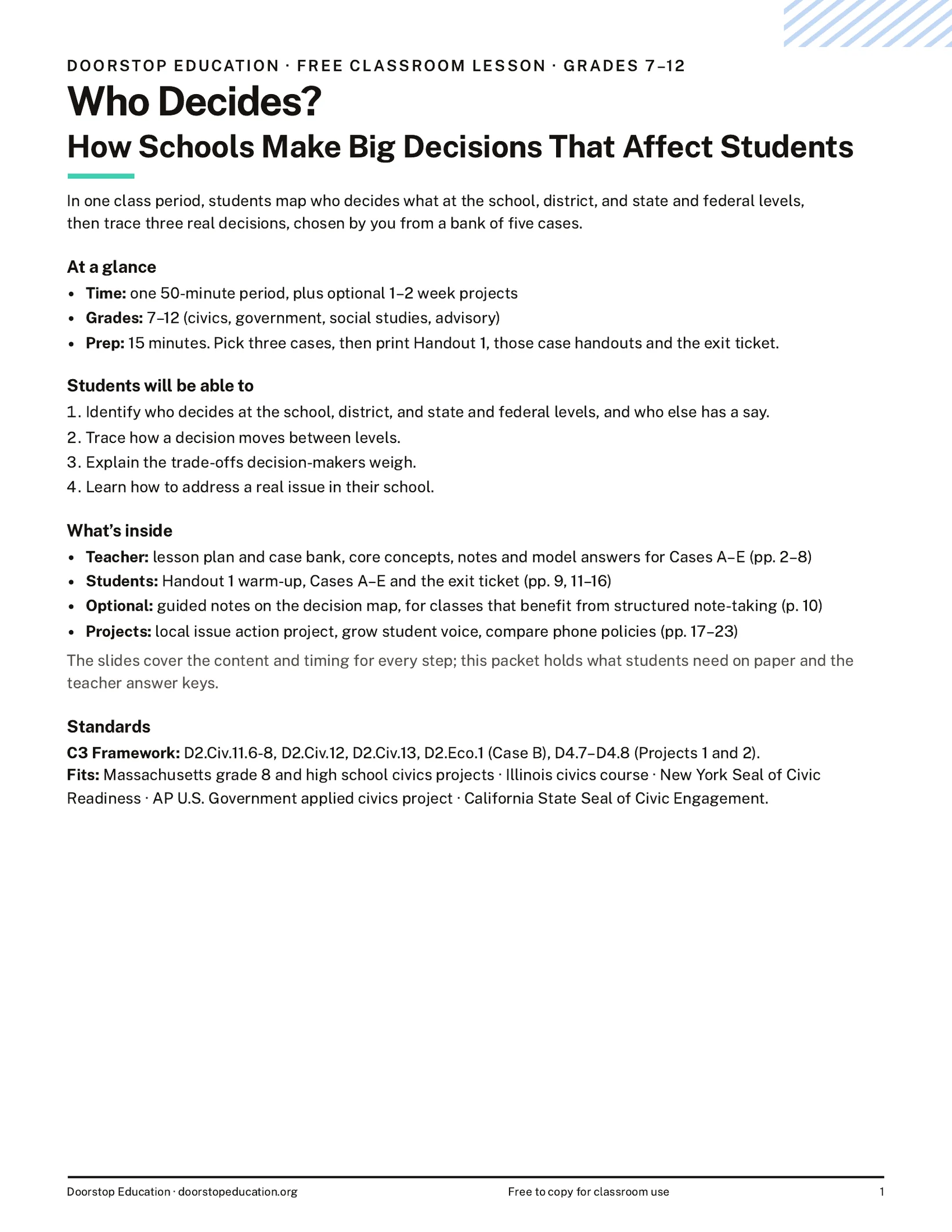
Everything you need to teach it tomorrow: a slide deck with timing, a teacher lesson plan with model answers, printable student handouts, an exit ticket and three optional projects. Copy it into your Google Drive and edit freely, or download print-ready PDFs.
Make your own copy
Opens in Google Drive and saves an editable copy to your account. Nothing to sign up for.
- 23-slide deck with timing for every step
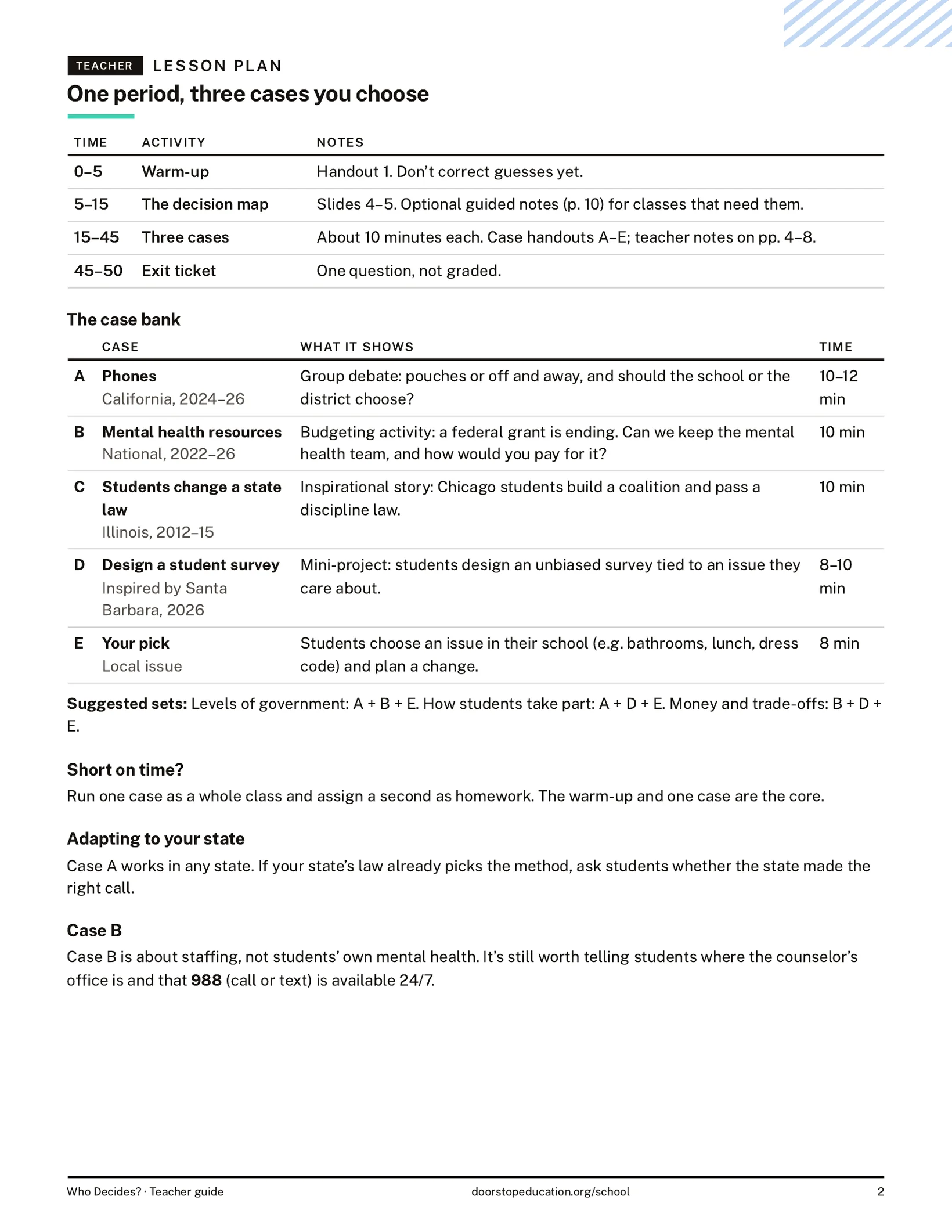
- Lesson plan, core concepts and a five-case bank
- Teacher notes and model answers for every case
- Warm-up, five case handouts and an exit ticket
- Three optional 1–2 week civics projects
Download the PDFs
Print-ready slides and the full lesson packet. Enter your email and the links appear right here.
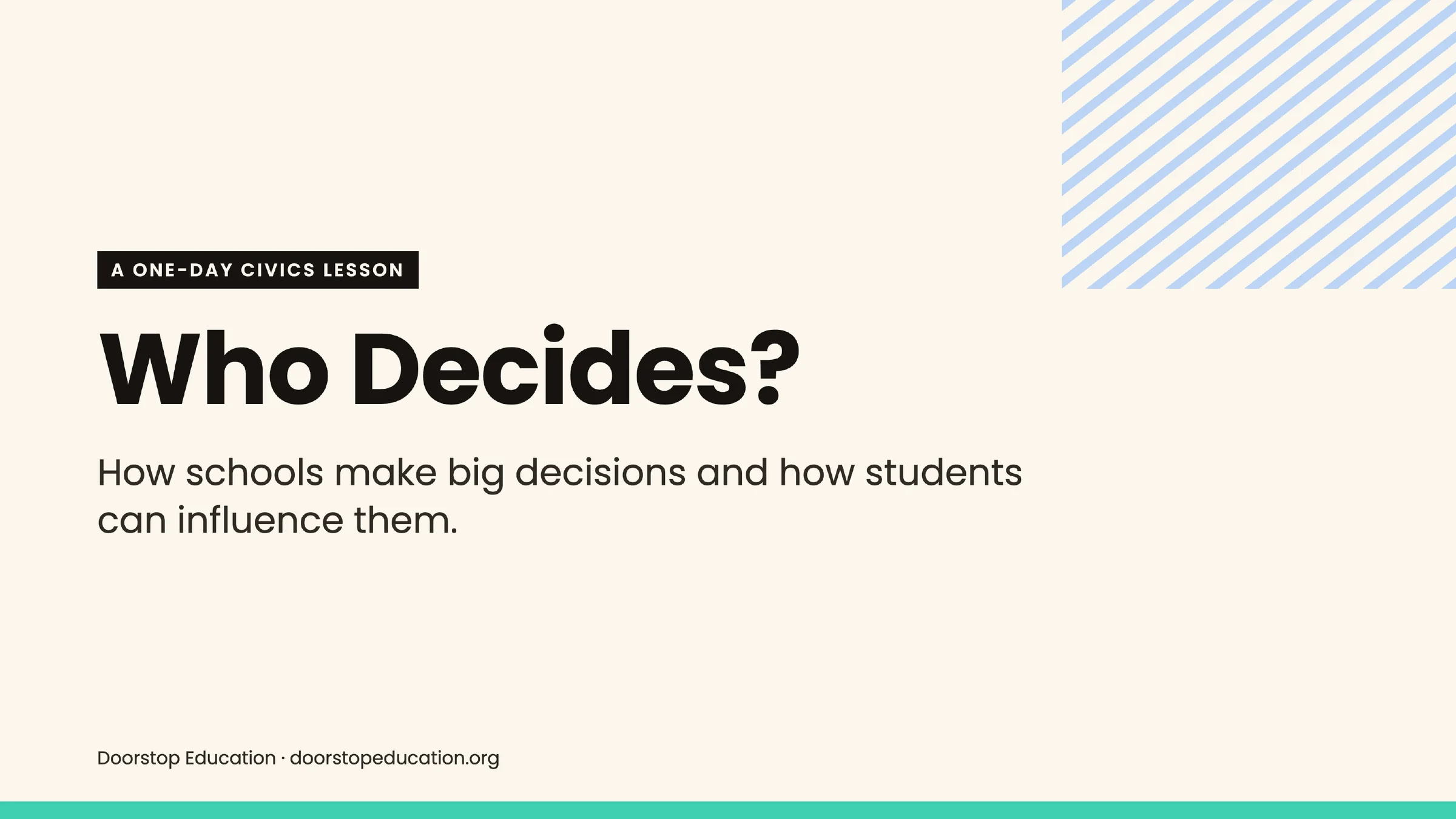
Preview the lesson
Slides
6 of 23 slides · click to enlarge
Lesson plan and handouts
6 of 23 pages · click to enlarge
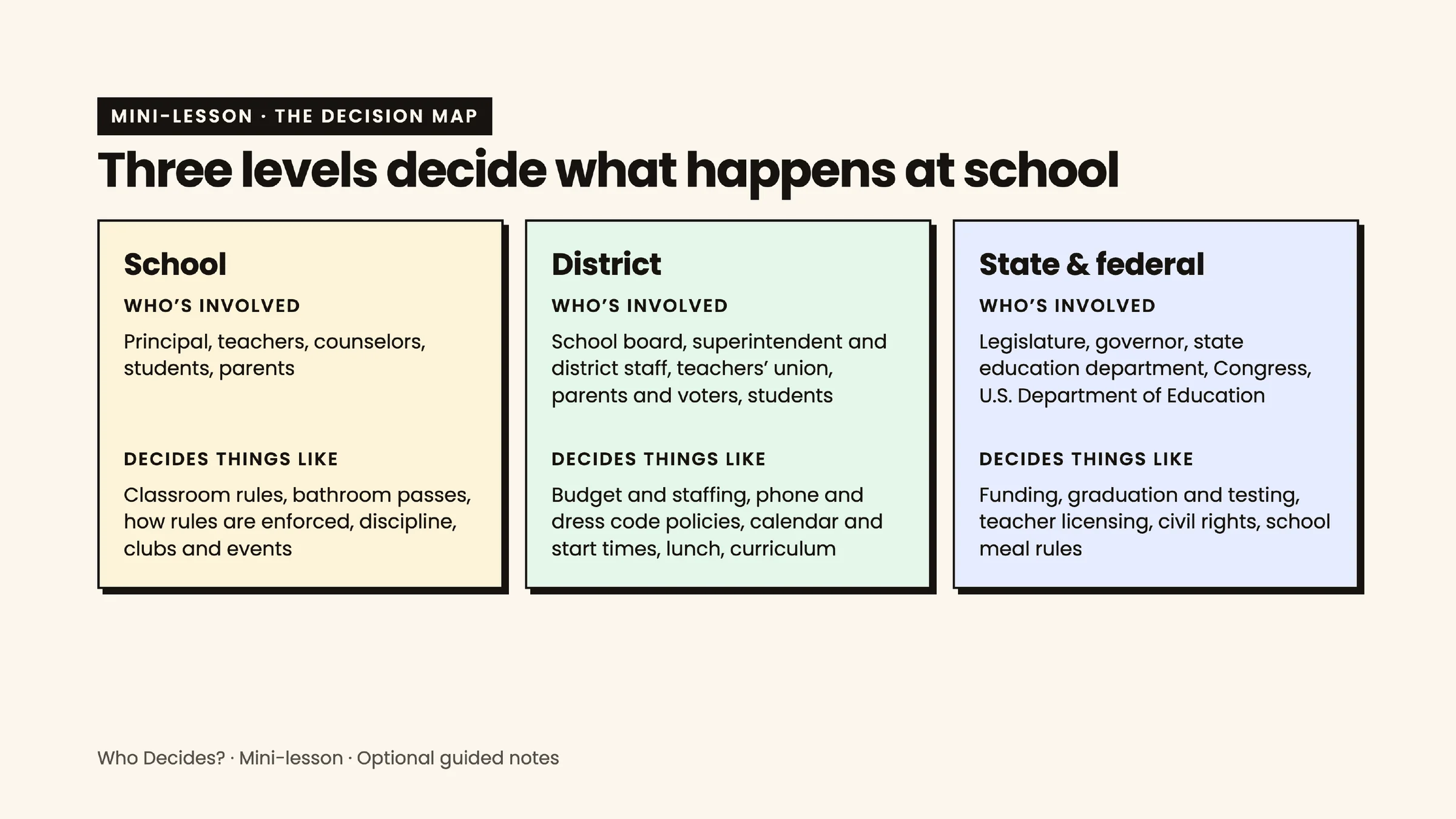
Who makes decisions in schools?
Every public school is run by four levels at once, and higher levels set limits the lower ones work within. Students start by guessing who could change something they care about, then build this map.
Your school
Principals and teachers run the building and carry out policy: how a rule is enforced, what happens in class, who talks to whom.
The district
The school board adopts policies and the budget; the superintendent and district office write the details. Phones, staffing, lunch vendors and dress codes are usually decided here.
The state
Lawmakers and the state board set standards, funding, graduation rules and mandates, like the phone restrictions most states now require.
The federal government
Congress and the U.S. Department of Education attach conditions to funding and enforce civil-rights law. They don’t write your school’s rules.
Real case studies, not hypotheticals
Pick three from a bank of five. Each comes with a slide sequence, a student handout and teacher notes with model answers.
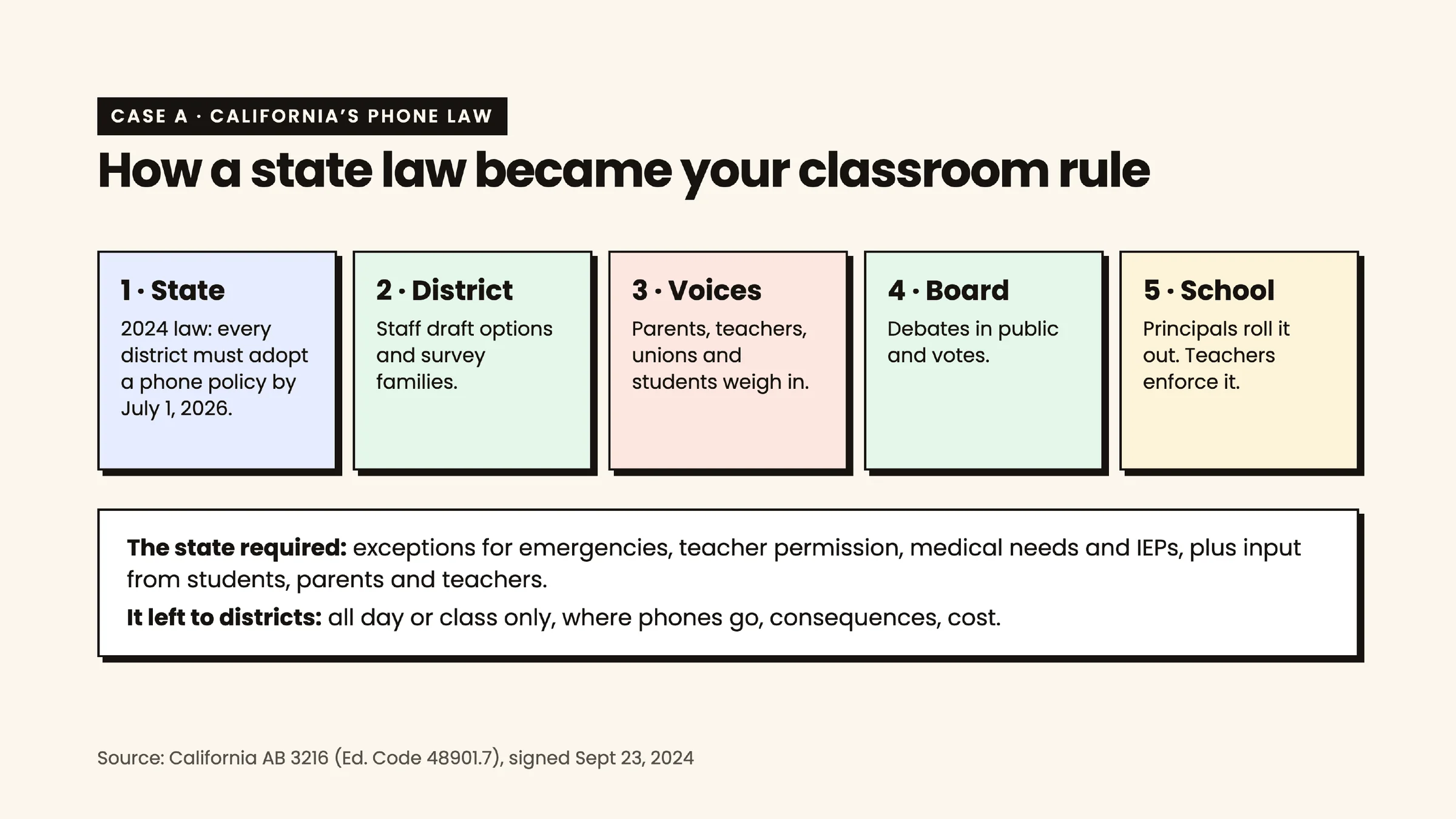
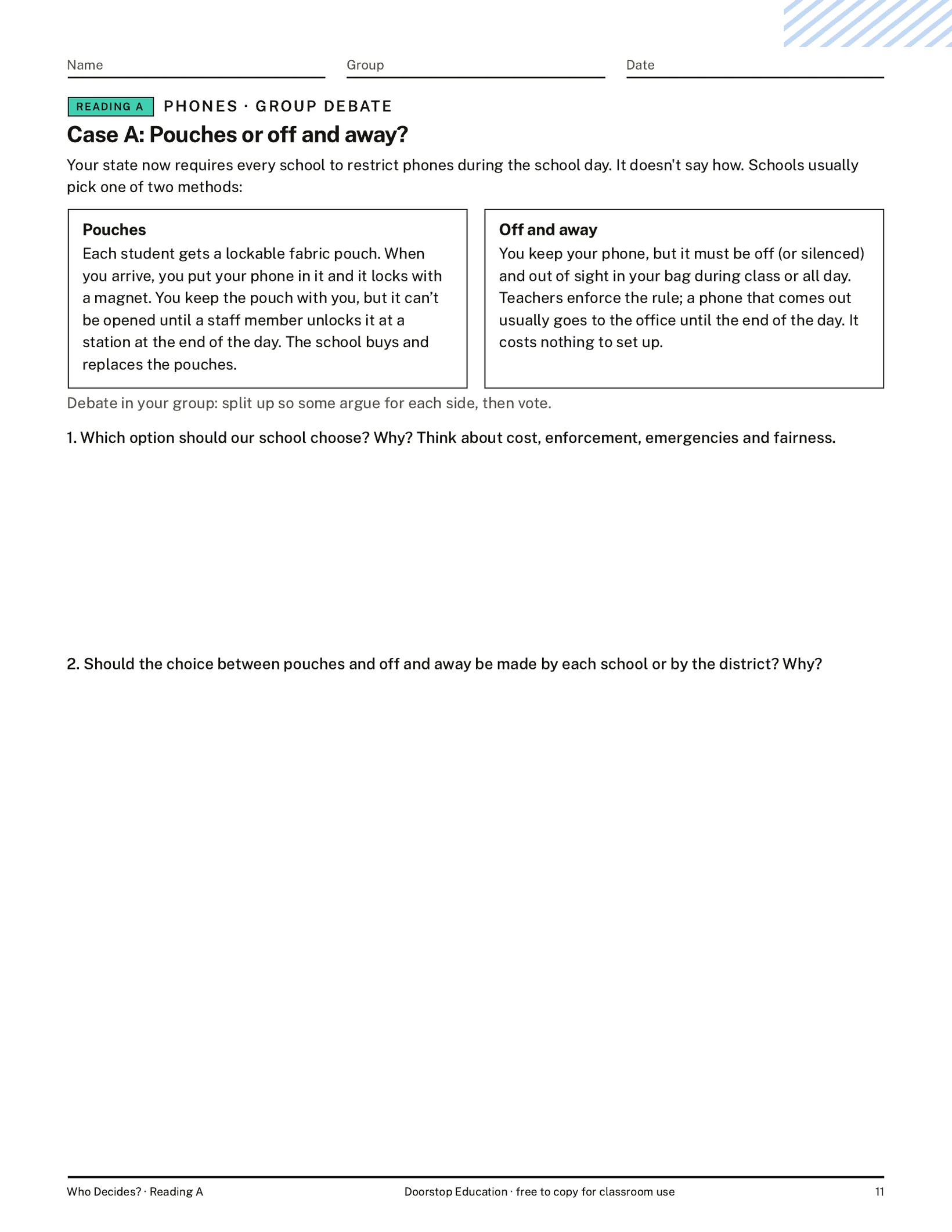
Phones: pouches or off and away?
California, 2024–26
A state law requires schools to limit phones but leaves the method open. Groups debate locking pouches against “off and away,” and whether each school or the district should choose.
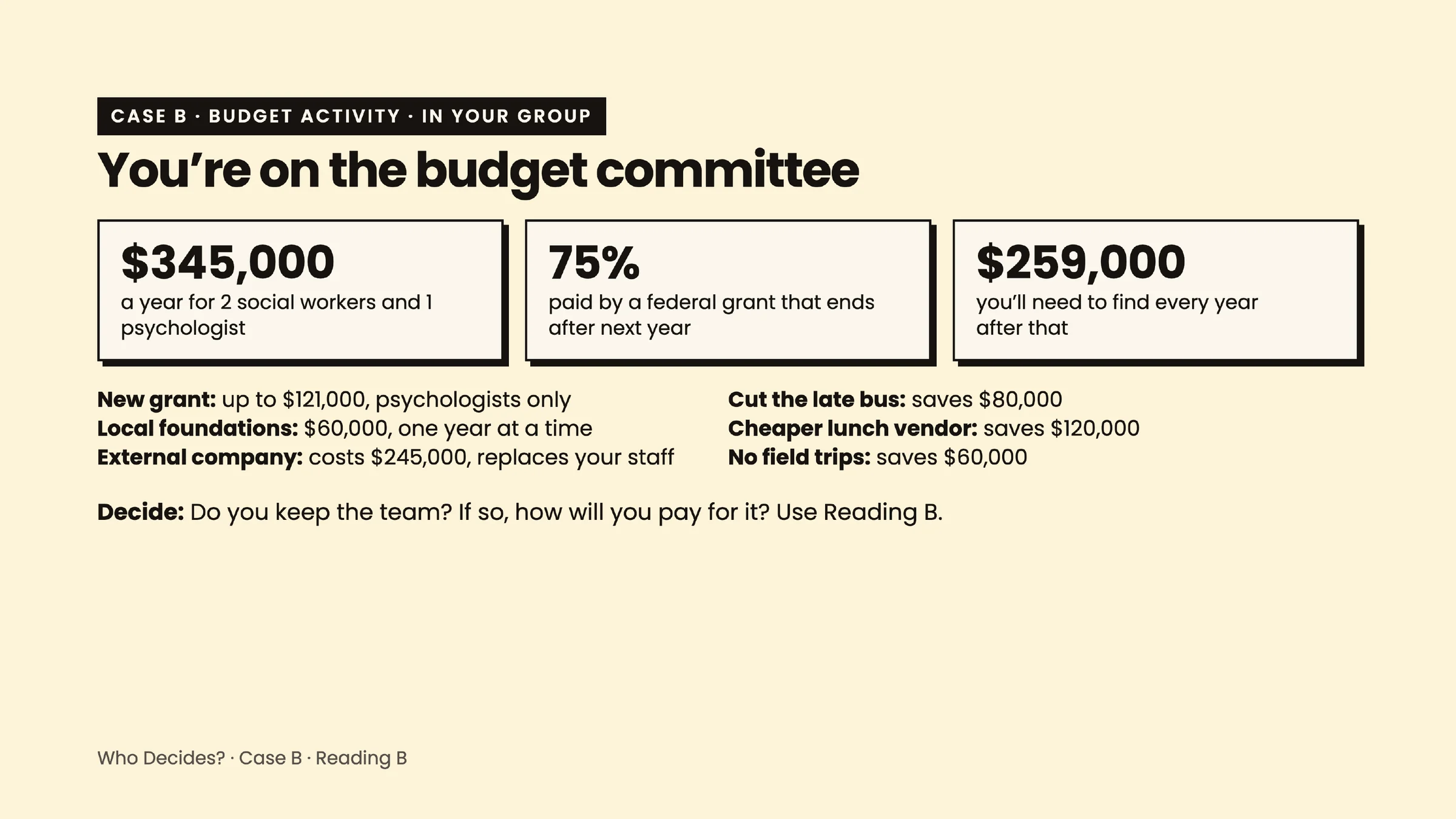
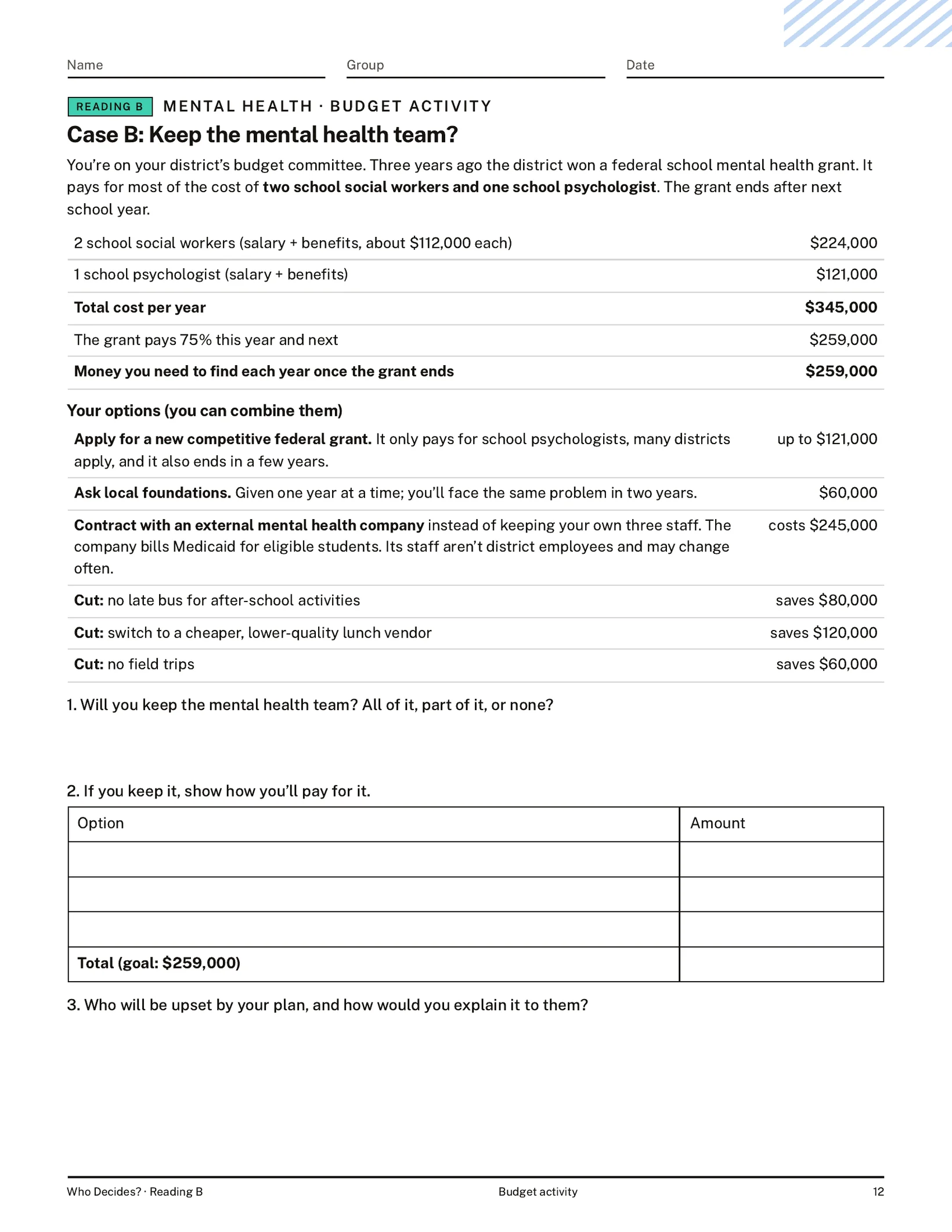
Keep the mental health team?
National, 2022–26
A federal grant that pays for two social workers and a psychologist is ending. Students sit on the budget committee and find $259,000, weighing grants, foundations, contracts and cuts.
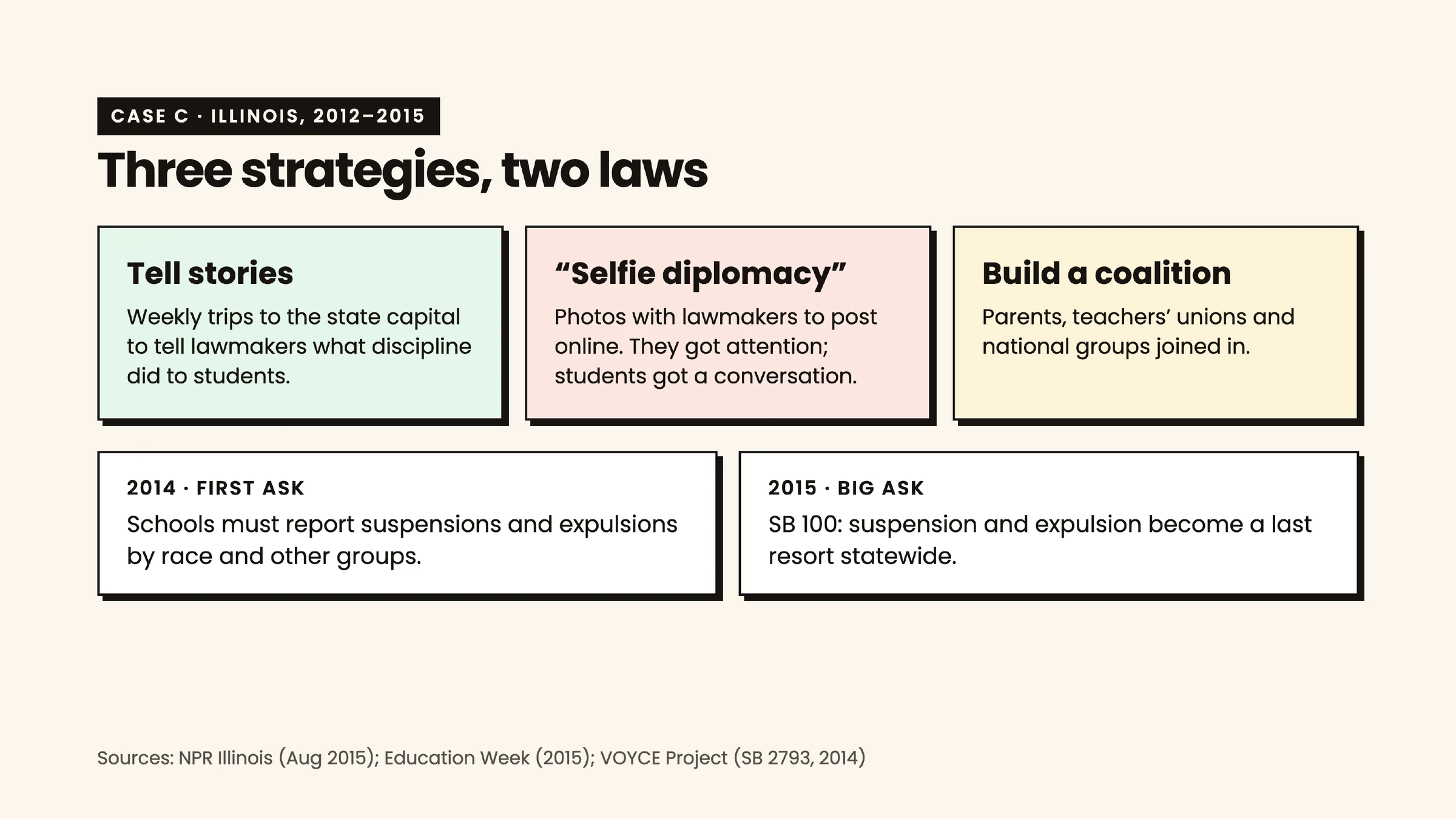
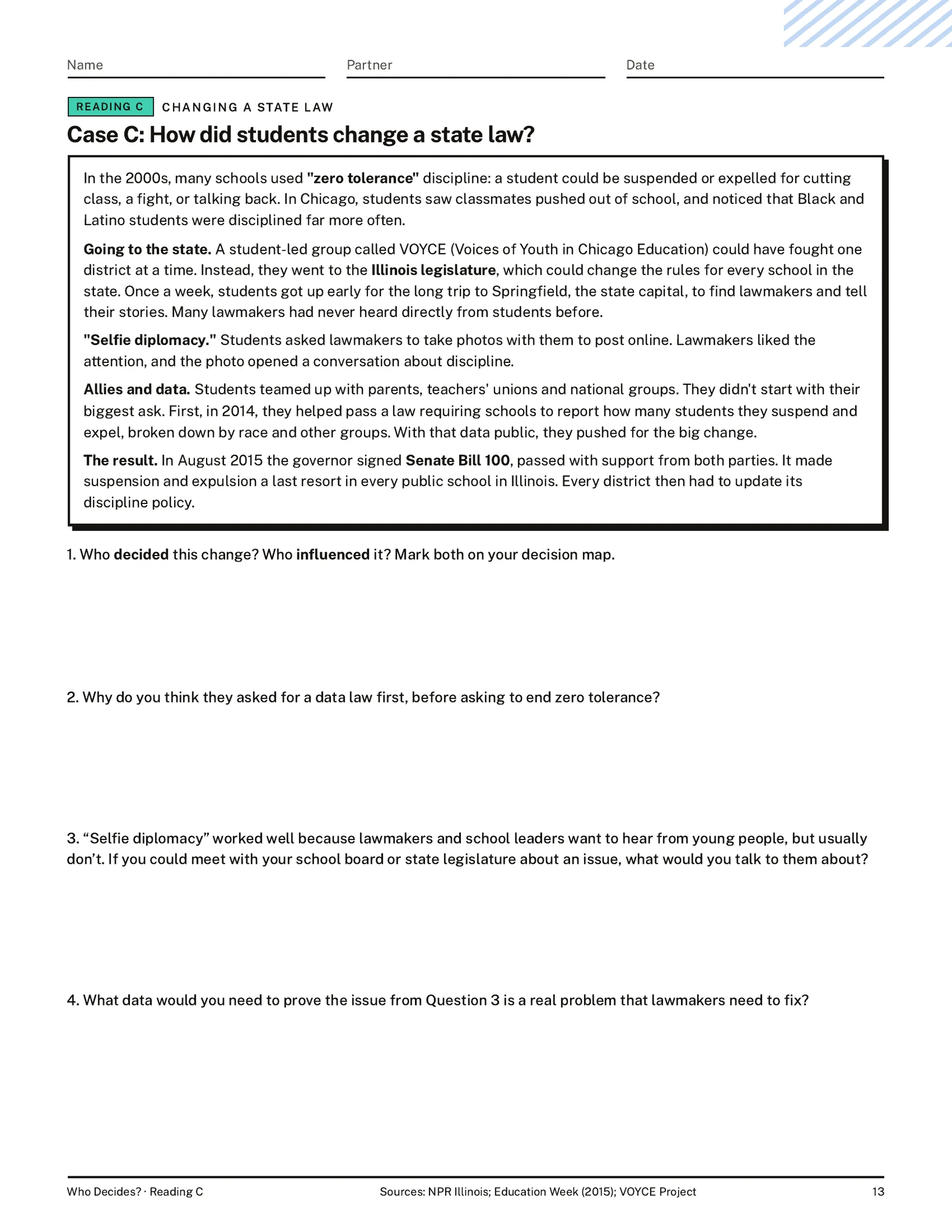
Students change a state law
Illinois, 2012–15
Chicago students in VOYCE skipped the district and went to the legislature, using data, coalitions and “selfie diplomacy” to pass Senate Bill 100, which made suspension a last resort.
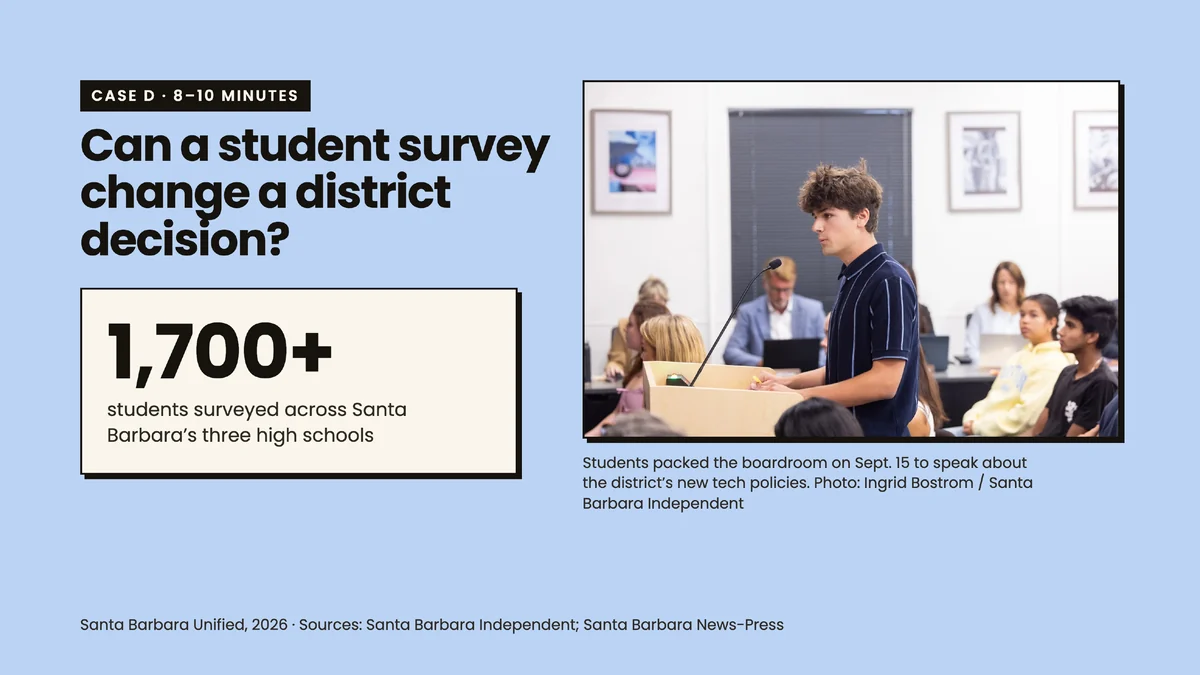
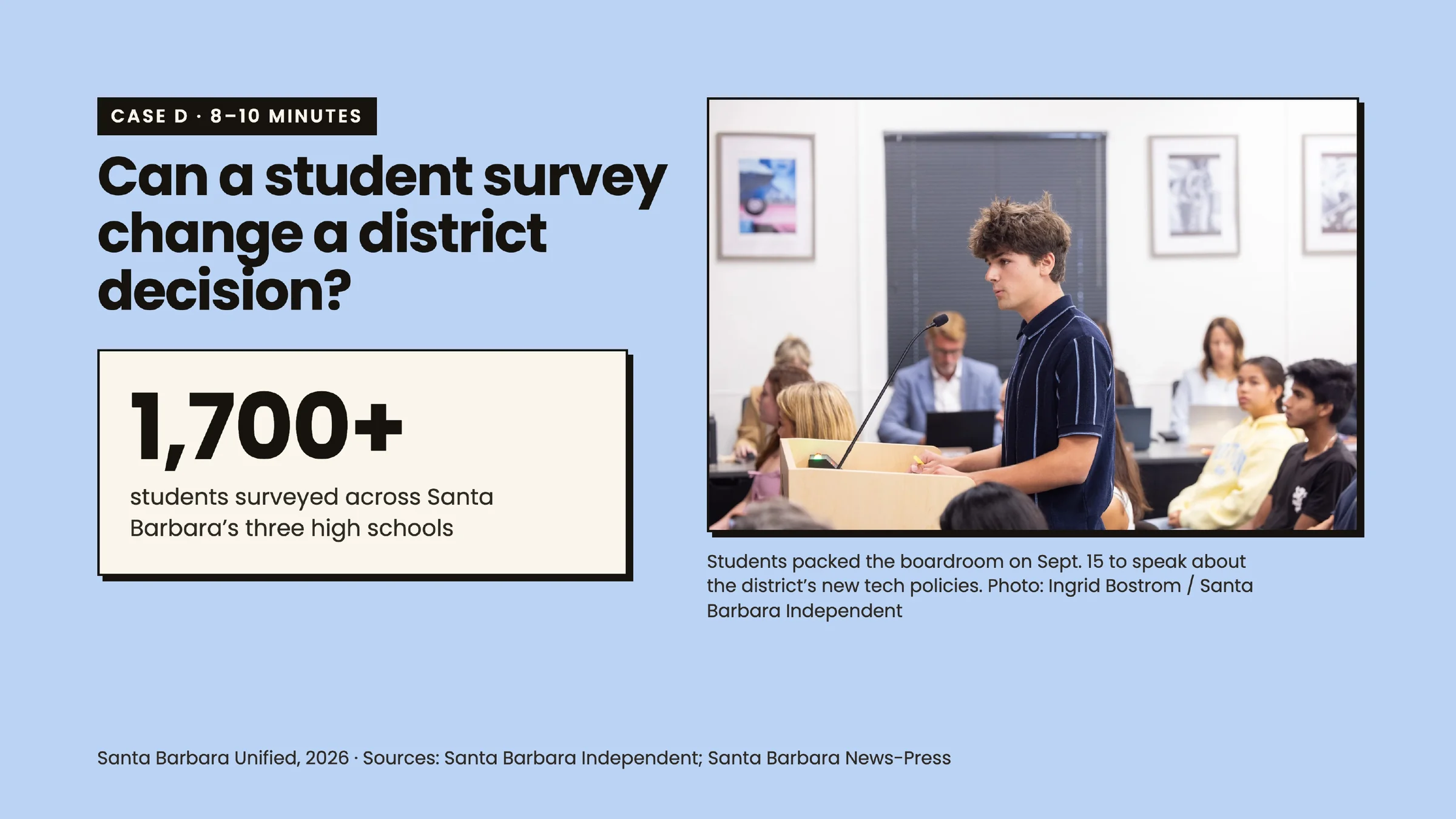
Design a student survey
Inspired by Santa Barbara, 2026
After 1,700 students answered a survey about a YouTube ban, the district listened. Students design an unbiased survey tied to outcomes their own school board cares about.
Your pick: a local decision
Your school
Students choose something they can see from their desk, like bathrooms, lunch or start times, then work out who decides it and one realistic first step.
Suggested sets: levels of government (A + B + E), how students take part (A + D + E), or money and trade-offs (B + D + E).
A one-period civics lesson plan
About 15 minutes of prep: choose your three cases and print the handouts.
| Time | Step | What happens |
|---|---|---|
| 0–5 min | Warm-up | Students name one thing they’d change and guess who could change it (Handout 1). |
| 5–15 min | The decision map | Slides walk through school, district, state and federal roles with real examples. |
| 15–45 min | Three cases | Pick three from the case bank, about ten minutes each, with handouts and model answers. |
| 45–50 min | Exit ticket | Students rewrite their warm-up idea and name who could change it now. |
Civics in school: three ideas for larger projects
Want more than one day? Each optional project has its own handout and turns the lesson into a student-led, non-partisan civics project about a real issue at school.
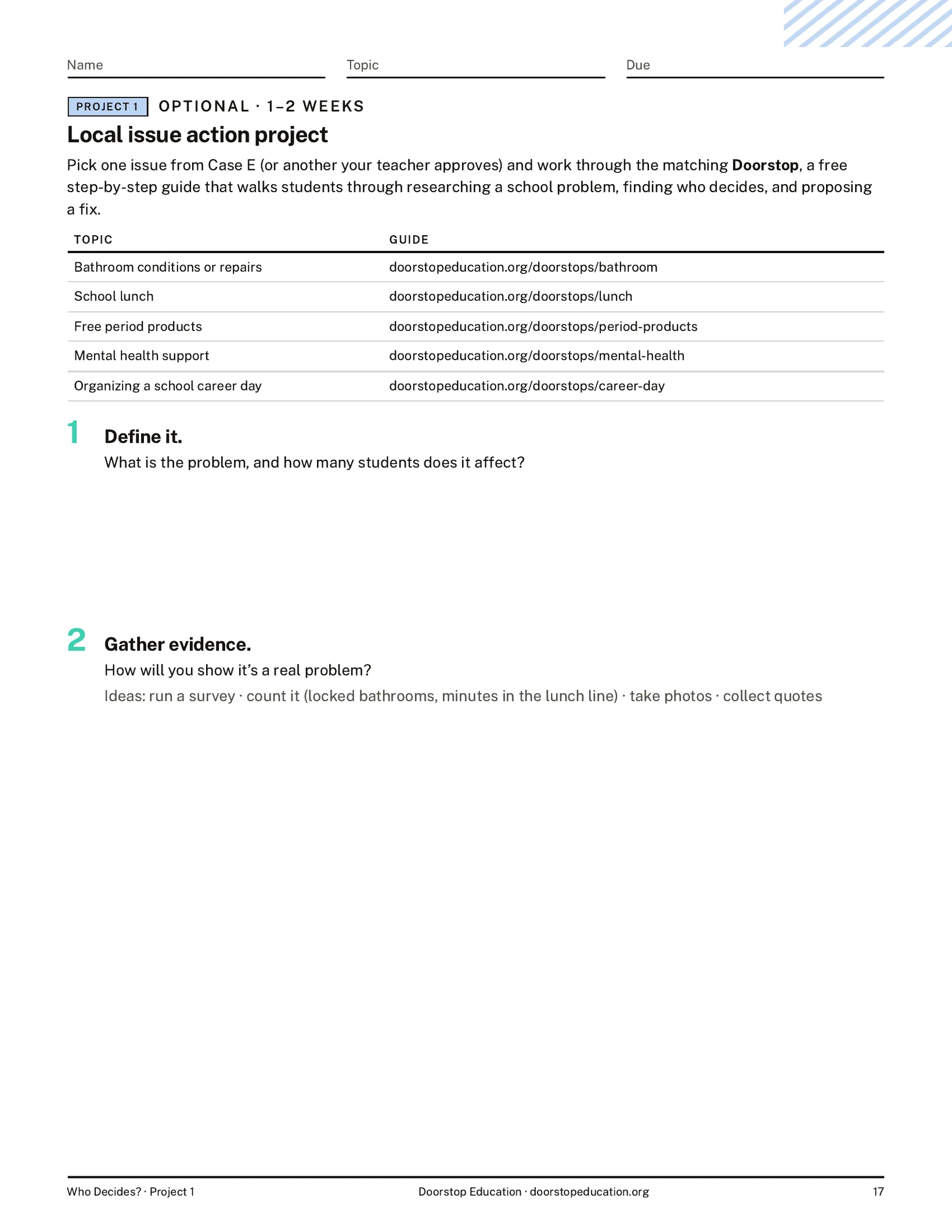
Local issue action project
Students define a school problem, gather evidence, find who decides, build support and make a specific ask to the right person, using Doorstop’s free step-by-step guides.
Grow student voice in school
Students research how their district hears from students (student board members, advisory councils, surveys) and draft a policy that gives students a real say.
Compare your school’s phone policy
Students find their district’s phone policy, compare it with two or three others in their state, and propose one evidence-based change.
Standards alignment
C3 Framework: D2.Civ.11.6-8, D2.Civ.12, D2.Civ.13, D2.Eco.1 (Case B) and D4.7–D4.8 (Projects 1 and 2).
Fits: Massachusetts grade 8 and high school civics projects, the Illinois civics course, the New York Seal of Civic Readiness, the AP U.S. Government applied civics project and the California State Seal of Civic Engagement.
Students will be able to identify who decides at the school, district, state and federal levels; trace how a decision moves between levels; explain the trade-offs decision-makers weigh; and learn how to address a real issue in their school.
Questions teachers ask
Who makes decisions in public schools?
Several levels at once. The principal runs the building, the school board sets district policy and the budget, the state sets standards, funding and laws, and the federal government attaches conditions to funding and enforces civil-rights law. This lesson has students map all four.
Who runs public schools, the state or the federal government?
Mostly states and local school districts. The federal government provides a small share of funding and enforces civil-rights law, but it doesn’t set your school’s rules or curriculum.
What does a school board do?
A school board adopts district policies and the budget, hires and evaluates the superintendent, and holds public meetings where anyone, students included, can speak during public comment.
Is this civics curriculum really free?
Yes. The slides, lesson plan and handouts are free, licensed CC BY-SA 4.0, and need no account. Make your own copy of the Google Slides and Doc, or enter your email to download the PDFs.
What grades and classes is it for?
Grades 7–12: civics, U.S. government, social studies and advisory. It runs in one 50-minute class period, and the optional projects stretch it to one or two weeks.
Does it work for the Massachusetts 8th grade civics project?
It’s built to launch one. The lesson shows students who decides and how to reach them, and the optional local issue action project walks a class through a student-led, non-partisan civics project.
What are good civics action project ideas for middle and high school?
Start with something students can see at school: the phone policy, lunch, bathrooms, start times or how students are heard by the school board. The three optional projects here give each one a step-by-step structure.
Teach it this week
Free under CC BY-SA 4.0. Questions or a story from your classroom? Email ben@fix.school.