Social referents program
How students can change school culture
Doorstop Education’s intervention to change school culture around toxic social issues like vaping, competitiveness, bullying, and mental health stigma.

The idea
Students follow students, not posters
Assemblies and rules tell students what adults want. What students actually do depends on what they think their classmates do, and they often guess wrong: four out of five young people overestimate how many of their peers vape or smoke (Truth Initiative).
Change the guess and behavior follows. A study of 56 New Jersey middle schools did it by enlisting a small group of students, and cut reported conflict by 30% in a single school year (Paluck, Shepherd & Aronow, 2016).
What’s a social referent?
Social referents set school norms
A social referent is a student other students pay attention to, and copy. What they laugh at, ignore, and act like tells everyone what’s normal.
They aren’t always the most popular. Every friend group has one: the captain, the group mom, the person who’s friends with everyone, the most dramatic drama kid.

How we run it
One semester, five steps
Survey students
A ten-minute survey in advisory or homeroom asks who each student spends time with. We tally the names and invite the most-named students, about 10% of a grade and at least one per friend group.
Pair them with an advisor
A counselor or teacher the students trust runs the room. Students lead the campaign; the advisor keeps it on track and handles anything sensitive.
Hold a kickoff
In 45 minutes, the group sees the survey results, hears the problem, and picks one visible change they want to make at their school. They choose it; we bring options.
Run the campaign
The group meets every two weeks through the semester. They put their own names and faces on it: posters, conversations with friends, a day the whole school notices.
Measure what moved
At the end of the semester, students take the same survey again. We compare the two alongside whatever the school already tracks, like discipline or nurse visits.
What it takes
From the school
- One staff advisor, usually a counselor
- A 45-minute slot every two weeks, at lunch or in advisory
- Ten minutes of class time for the survey, twice
- Wall space for posters
From Doorstop
- The survey, and a tool that tallies nominations
- A kickoff agenda and invitation letter
- Campaign options, from the studies and from other schools
- A before-and-after summary of the results
Campaigns
One method, any norm
The group picks one problem. These are the ones schools ask about most.
Vaping
Most students think more of their classmates vape than really do. Referents close that gap.
- Most of us don’t: post the real survey number
- Their own faces on it: referents say they don’t vape
- Stop handing it down: older students agree not to give vapes to younger ones
Competitiveness
Grades and rankings turn classmates into rivals. Referents make it normal to stop keeping score.
- Stop asking people what they got on a test
- Celebrate a friend’s win out loud
- Share notes and study guides instead of guarding them
Bullying and conflict
The original Roots campaign. Referents chose their own hashtags, made posters with their own photos, and handed out wristbands to students they saw being kind.
Mental health stigma
Words like “depressed” and “trauma” used as jokes make it harder to tell when a friend is struggling, and harder to ask for help.
- Say what you mean: “stressed,” not “traumatized”
- “Wait, are you okay?”: notice the friend who means it
- Why I stopped saying it: referents share their own reasons
What the research says
Tested in real schools
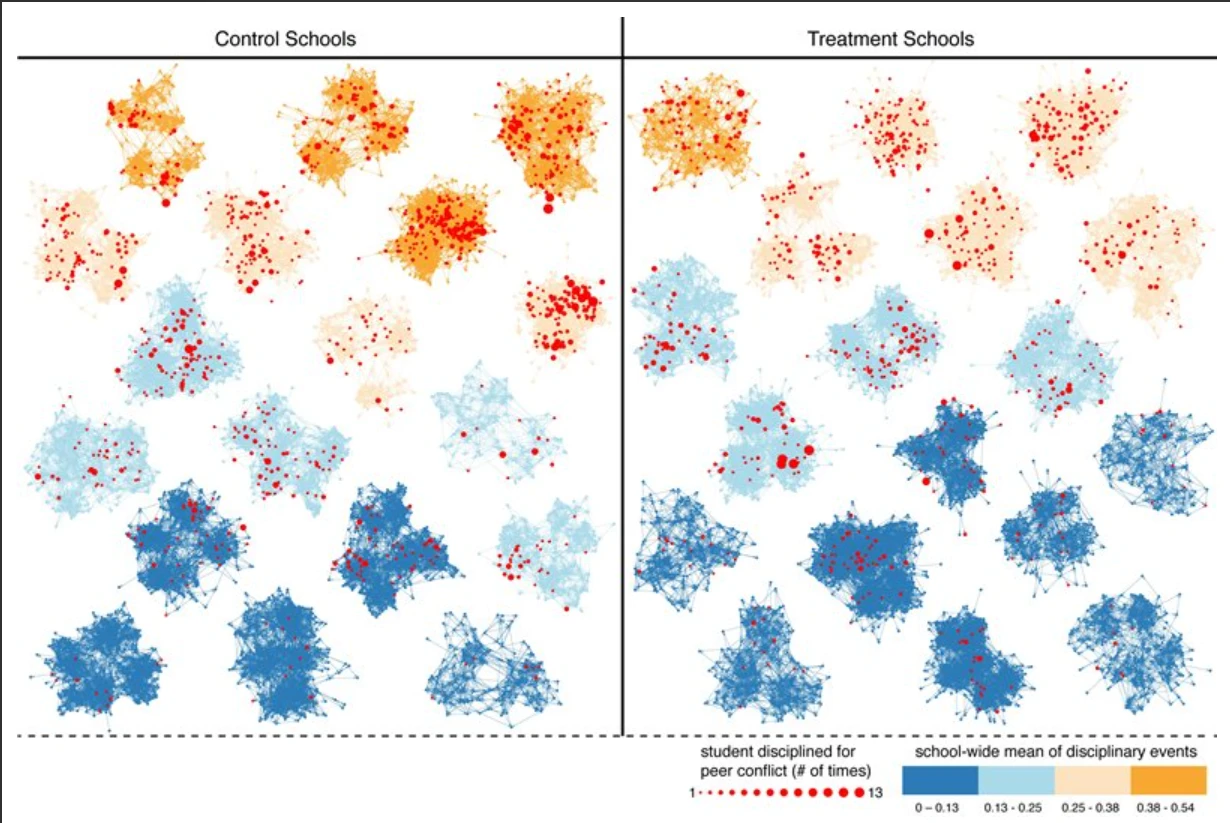
Roots (56 New Jersey middle schools). Students named up to ten schoolmates they spent time with. In half the schools, the most-named students, 20 to 32 per school, met with an adult every other week and designed their own anti-conflict campaign. Disciplinary reports of conflict fell 30% compared with the other schools, and the drop was larger where the group had more referents in it (Paluck, Shepherd & Aronow, PNAS, 2016).
ASSIST (59 UK schools, 10,000+ students). Students answered “Who do you respect?” and “Who do you look up to?” The most-named 17% were trained for two days, then talked to friends about smoking for ten weeks. Smoking was about 22% lower over the next two years (Campbell et al., The Lancet, 2008).
Sources of Strength (18 high schools). Peer leaders trained with adult advisors were about four times as likely to bring a suicidal friend to an adult, in the larger schools. Across the student body, more students came to believe adults at school could help and that asking them was okay (Wyman et al., American Journal of Public Health, 2010). A larger later trial was mixed on suicide attempts.
Where the evidence is thinner. For vaping, a trial of peer-nominated 8th and 9th grade leaders reported 6.0% past-month vaping against 6.9% in comparison schools, without significance tests (NCT04678245). We found no study of competitiveness campaigns or of how students joke about mental health. Those campaigns rest on the same method, and the before-and-after survey is how a school finds out whether it worked.
Questions schools ask
Before you say yes
Isn’t this just the popular kids?
No. The survey asks who students actually spend time with, not who is popular, and we invite at least one student from each friend group. In Roots, the effect was largest where the group had more of these well-connected students, whoever they turned out to be.
Who sees the names?
Only the advisor. Students are invited privately, the survey results are shared as counts, and no one sees a ranking.
What grades does it work for?
Roots ran in middle schools and ASSIST with 12- and 13-year-olds. Sources of Strength used the same idea in high schools. We’ve planned it for grades 7 through 12.
What if students pick something we can’t support?
The advisor is in the room, and the group chooses from options the school has seen. Nothing goes up on a wall without the advisor’s okay.
Get started
Bring it to your school
Tell us your school and the problem you’d start with. We’ll set up a call.
Are you a student who wants to start one? Use the student guide.