
College · Seniors
Personal essay practice
Stand out on your college applications by getting comfy writing about your emotions.
Even though essays are considered to be a third of your application—as important as all of your grades and test scores combined—most students have never written about themselves before. Writing college essays takes a skillset completely different from the analytical essays you write in school.
Through a series of writing prompts and short readings, this guide will walk you through developing that skillset.
How this works
For each prompt, you’re going to write a one page-ish response that’s concise, flowing, and emotional. Your goal is to present an idea, and make that presentation more interesting with a personal experience or your own feelings. Unlike an analytical essay you write in school, you’re encouraged to use “I.”
Emotion elevates essays into passionate, compelling arguments and powerful, evocative ideas. A personal touch adds humanness to writing. Look at two versions of the next concept, which explains why.
- Emotion elevates essays into passionate, compelling arguments and powerful, evocative ideas. A personal touch adds humanness to writing.
- I spent high school scribbling together bland, “persuasive” essays that I knew wouldn’t persuade anyone—or be read by anyone other than my teacher. It felt silly to write something only my teacher would ever read, and the only page of USA Swimming magazine I’d read: the comic strip. The difference between this writing and mine wasn’t anything profound or unexplainable: the authors just cared. Passion elevated their paragraphs from solid arguments to compelling stories, from logical ideas to emotionally resonant messages. I wanted to do the same.
I wrote the second version by saying how I felt about writing instead of focusing on the objective truth (I was unhappy writing school papers vs. emotion makes essays great). I cut out all the phrases that work in conversation, but don’t add meaning to my writing (“or even be read by anyone other than my teacher… I wasn’t all that proud of my work.”) I included phrases that made it clear the writing was personal (“novels I loved”). I tied back to my main argument, that emotions make essays human, and therefore better.
I wrote the first version before the second, but I had the emotions described in the second version long before I tied them to an argument.
Exercise 1
Respond to a simple prompt, then—feelings
An introduction to writing about yourself.
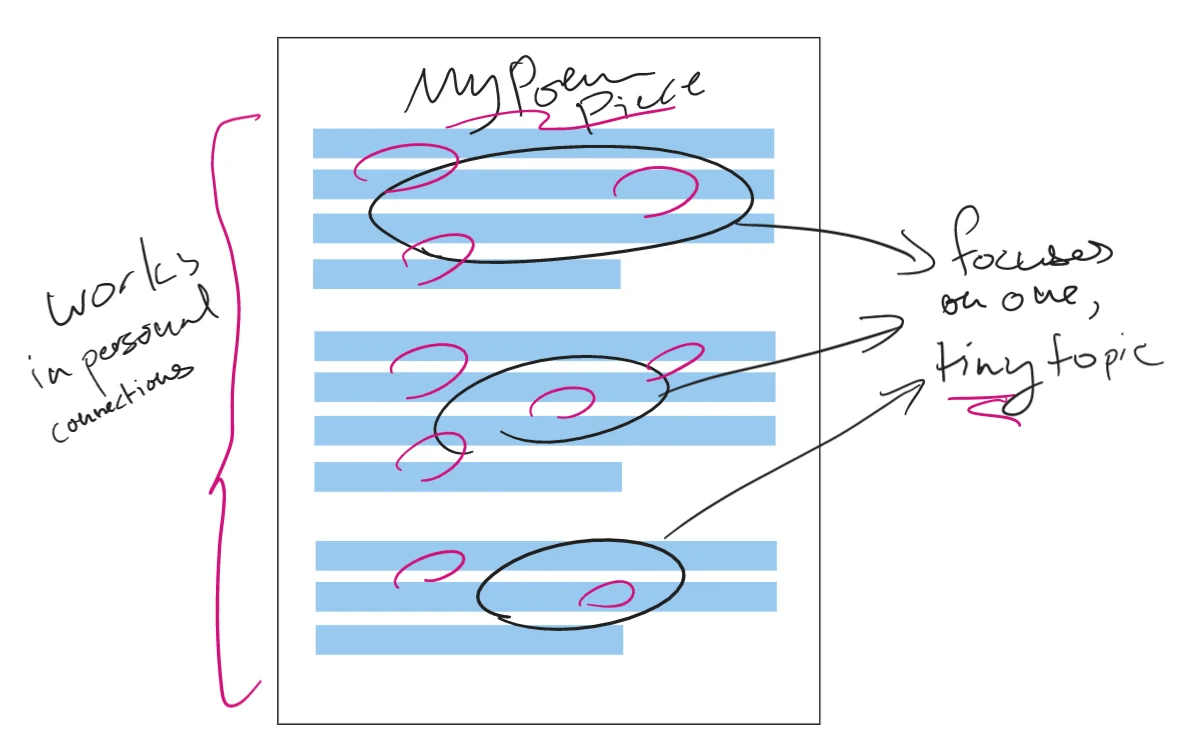
You might be asked to write an argument or talk about an idea, tell a story or—as with this prompt, teach a skill:
You’ll have to bring in your emotions and experience to do the pink part.
- if you have a bullet pointed list of steps, you could say “(My favorite step!)” in one of them
- if you are talking about a hard part, you could interject, “This was really frustrating when I first tried it.”
- you could share a personal story or funny moment
- you could talk about what motivates you to practice the skill
Any skill you know—from how to juggle to how to find good animal pictures online—is worth teaching, but choose a topic you care about—that’ll make it easier to get the reader excited! You’ll have plenty of emotion, anecdotes, and ideas to weave in. Your final product doesn’t have to be exactly a page (notice how I’m not specifying spacing, margins, or font), but try to write something that responds to the prompt in a concise and emotionally compelling way.
To better understand what a good final product looks like, let’s take a close read of a few examples ranging from “I wrote this in five minutes” to exemplar. Look for what they did well and what could be improved on, then write your own!
Further practice
- A time you broke the rules
- A time you tried something new
- A time you built something
- A joke about your life as a ninth grader
- A yard sign with you running for school committee president
- Your manifesto about why some system or institution should change
- Snow
- Write about a memory, pretending it’s happening this second
Exercise 2
Ask “recursive why” questions
A multimedia activity on sports.
“Everyone has a swimming story to tell,” Bonnie Tsui says in her book, Why We Swim. Do you have one? More importantly, why do we—as humans—swim? What draws us to the water? Take a few minutes to think. If swimming’s really not your thing, you can follow this exercise with any hobby, sport, or activity you enjoy.
I wanted an answer—I was a teenager who had spent half his time in the water and suddenly realized he had no idea why. Tsui’s book covers many of the physical, social, and emotional reasons humans swim, but none of the answers resonated with me.
Tsui was asking a different question. She explained why humans as a whole swim: her general answers couldn’t perfectly match my specific question, why do I swim? Neither question is wrong, but they are different. If you think in terms of who, what, when, where, why, and how, this is who.
Let’s try to find an answer by breaking each question into parts. Why humans swim is very broad: you can imagine Tsui writing a whole book on it. Why I swim is narrower, but still a very large question: You’d have to deconstruct ten years of my life to answer, going into different teams I swam for, different strokes, different emotions… wait a second. We’re on to something here.
We can answer broad questions by breaking them up into parts. Say I wrote a one sentence essay, “I swim because it makes me happy.” That would be lame. The natural follow up question would be, “Why does it make you happy?” Well, the community of friends on my team make me happy, exercising makes me happy, and I like feeling weightless in the water. Here’s the recursive part, where we repeatedly ask deeper and deeper “Why?” questions: Why does your swimming community make you happy? Why does exercising? Why does weightlessness? Now we have three much narrower essay topics that we can dig into.
This recursive why concept applies on the idea level and on the paragraph level. Let’s take a look at an unpolished example:
Making precise, sentence-by-sentence arguments requires explaining each step. For each sentence, if there’s a non-obvious “why?” question worth asking, answer it! Go through the paragraph and ask questions that will make the paragraph stronger.
This is the paragraph’s topic sentence, but it is too short! It doesn’t clarify why weightlessness makes me happy, forcing the reader to go into the rest of the paragraph blind. Let’s keep reading to find a compelling phrase we can add.
There’s no “why” question worth asking here. This sentence states a fact. I could talk about why I injured my knees, for example, but it wouldn’t be relevant to this paragraph’s argument.
This sentence covers a lot of ground very quickly. Why is there physical pain associated with expressing emotion? Why does the pain of expressing the emotion stop me from feeling it? Let’s give it another go.
In yellow are places where the reader will implicitly ask “why?” and “how?” In green are tactics I used to explain. I added transitional phrases: “I used to be” ties this sentence to the previous one—the original version felt like a separate thought; “Unable to express myself on land” takes the reader from my statement of fact in the previous sentence (“I stopped feeling emotions as intensely”) to an argument that was previously unclear (Why did not expressing my emotions stifle them?). I also gave examples: what does being “jumpy and excited on land” mean? This was a place readers would get confused.
The colon is highlighted because again, it’s a place where the “why” is expressed. This sentence is already solid.
These sentences already use examples and clear explanations. In this concluding sentence, the “why” works in reverse. “Swimming is my cathartic outlet” because of all the reasons I’ve laid out in the paragraph.
Now, we have some more context on what the topic sentence should look like. Try to rewrite it yourself! Don’t be afraid to tap into the recursive part. We only did one revision, but you can work through several, asking more precise why questions and deciding whether an answer would strengthen the argument.
Logical arguments are only one approach: especially when discussing an abstract question like why we swim, emotional claims are as valuable as practical ones. If I wrote about seven scientific studies on how the feeling of weight correlates with depression, it might be a logical argument, but readers won’t be able to relate to it.
Exercise 3
Where is the beauty in ordinary things?
Describing the same object or event in many ways.
For a raunchy, scribbling beep-bop almost fantasy, read chapters 12 & 13 of On the Road. Then, if you like this, check out Mañana Means Heaven from your local library.
The essence of a description: haiku
Read these three, then flesh one of them out into a full paragraph.
Dim light in the velvet room,
Jazz should be playing—
Instead, a murmur.
Shattered windows cry,
there was once dancing here!—
fog rises higher.
fake plants and distance,
unconquerable distance—
estranged eyes meet
Examples
Exercise 4
Engaging readers from the start
Read Ann Patchett’s “These Precious Days” in Harper’s.
What is the essay about? What is her literal advice for writing—and how does she craft an effective story? What keeps you reading?
Finished the essay? One final, critical question
After hearing everybody complain about the same problems they had with Covid and being bored to death about it—why does her “Covid Essay” work?
Keep practicing
Write a lot. Read a lot—personal essays if you can find them, but all published writing has an exceptional quality to it. Every piece is unique, but they share so many things in common. Discover all of that. Analyze the choices they make in every sentence and paragraph. Emulate them until you don’t need them anymore. Treat your application like a work of art because it really can be beautiful.
If you’re out of ideas about your own personal experiences, write about someone else’s. Here’s a collection of ideas—believable absurdities, I’d call them—to use as prompts: Harper’s Weekly Review.
Find your own resources for inspiring great writing on all levels: words, sentences, paragraphs, and ideas. And when you’re ready to polish, run every draft through the college essay checklist.
Next steps
Unique applications aren’t what you think
What Harvard’s own documents say about standing out, and why passion beats a perfect résumé.
Read the guide →The college essay checklist
Go through every essay and supplement, one question at a time, before you hit submit.
Read the guide →Great recommendations come from asking for help
How to build real relationships with the two teachers who’ll write about you.
Read the guide →All college guides
Back to the full list.
Read the guide →